


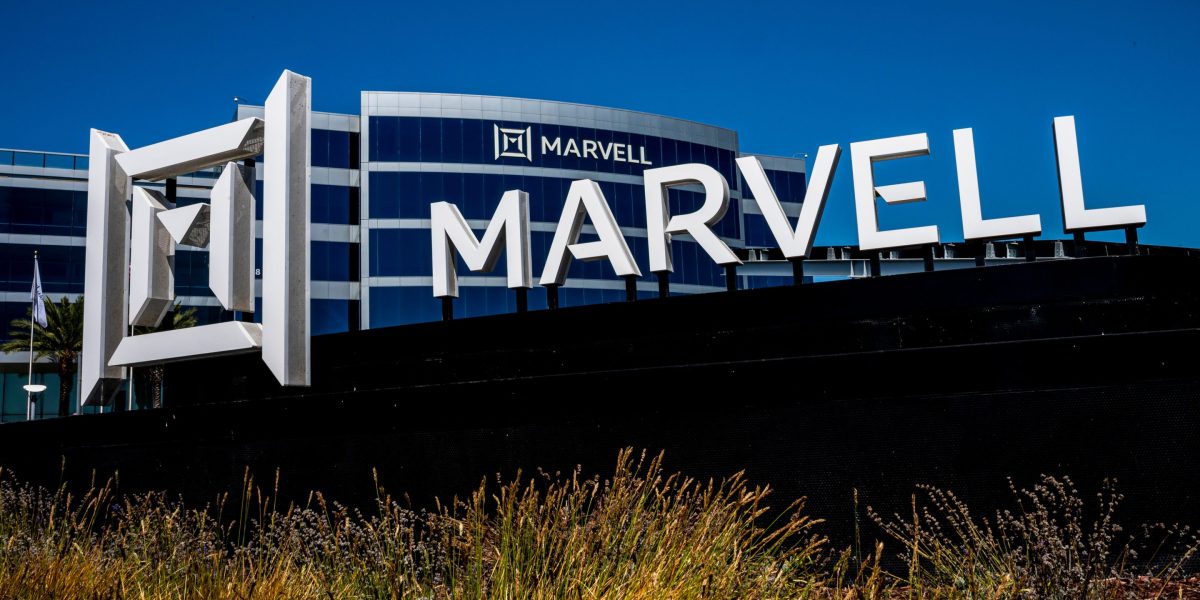
The semiconductor company and the electronics manufacturing firm, respectively, will replace Pool Corp. and The Campbell’s Company before the start of trading on June 22, according to the index provider.
Marvell in its latest earnings delivered a quarterly forecast that exceeded estimates and boosted its outlook for the year, citing demand for chips used in AI data centers. The company is benefiting from a surge in demand for computer systems in data centers that create and run artificial intelligence software and services.
Flex, meanwhile, issued profit guidance for 2027 that exceeded consensus estimates. The company announced it will spin off its cloud and power infrastructure segment.
Shares in Marvell rose 6% in after-hours trade and Flex was up 2%.
Companies must have a market capitalization of at least $22.7 billion and meet profitability, liquidity and share-float requirements to qualify for the S&P 500 under April guidelines. Removal from the benchmark can weigh on a stock, as index funds sell shares to realign with the gauge’s new composition.
The growth of passive investing has elevated the importance of inclusion in the US equity benchmark, as funds that track the index must buy newly added shares. The same goes with exclusion. Just on Thursday, the index provider announced it will keep its existing eligibility requirements for benchmarks, closing the door to fast entry for big tech IPOs like SpaceX.
The decision arrives as Wall Street grapples with a new reality: some companies are reaching unprecedented sizes before they ever enter public markets.
Read more: S&P’s SpaceX Snub Shows Elon Musk the Power of Index Gatekeepers
SPDJI said it will not shorten the 12-month seasoning period for giant newly public companies or waive existing profitability and public-float requirements based on a company’s size, diverging from a broader industry shift embraced by rivals Nasdaq Inc. and FTSE Russell.
This means Elon Musk’s rocket company, among others, will not get immediate access to one of the largest and most reliable sources of demand in modern markets: the trillions of dollars benchmarked to the most widely followed stock index.
Quicker inclusion in the benchmark would have led to about $14 billion in forced passive buying for SpaceX, more than $8 billion for OpenAI and about $4.6 billion for Anthropic PBC, according to Bloomberg Intelligence estimates.
Read more: SpaceX, Other Mega IPOs Denied Fast Index Entry by S&P
In March, Vertiv Holdings Co., Lumentum Holdings Inc., Coherent Corp. and EchoStar Corp. were added to the index, replacing Match Group Inc., Molina Healthcare Inc., Lamb Weston Holdings Inc. and Paycom Software Inc.