
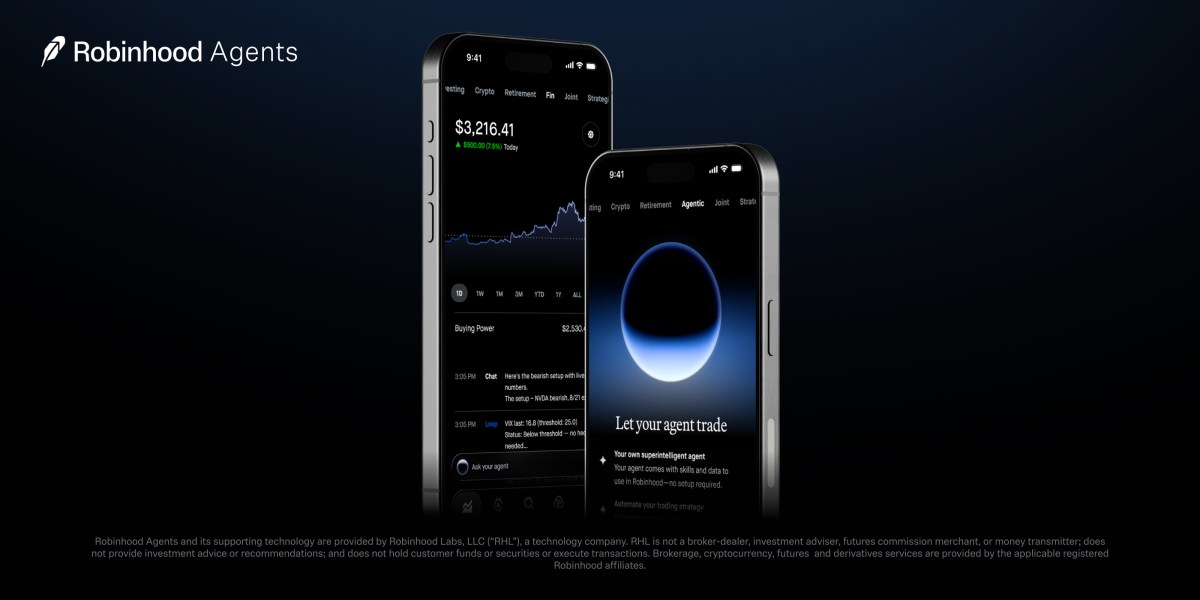


Starting this week, all of Robinhood’s roughly 29 million customers will have access to trading agents powered by OpenAI and Anthropic. The customers will be able to choose between various OpenAI and Anthropic models, and instruct the agents to carry out trades, conduct research and build complex investment strategies.
The rollout, which coincided with Robinhood’s annual HOOD summit, follows a move by the company in May to release a so-called MCP tool that allows technical users to hook up their own agents to its trading platform.
While AI has been creeping into every corner of finance, Robinhood is the first to release a non-technical trading agent for a giant customer base—a step that has the potential to alter how Americans invest, and that could have ripple effects on markets more broadly.
In a demonstration viewed by Fortune, a Robinhood user was invited to give their agent a name, and then choose between OpenAI’s GPT-6 Luna or GPT-6 Sol, or Anthropic’s Opus 4.8.
Once configured, the user could then provide plain English instructions to the agent, which was able to execute tasks ranging from simple trades like “Buy $200 of Ford stock” to more complex assignments like “Loops.” As Robinhood explains, “you can set a Loop to check the market every morning and execute a trade when certain conditions are met, or run a continuous overnight strategy to look for opportunities while you sleep.”
Robinhood’s new offering also comes with a series of guardrails that the company says will prevent agents from behaving in an unexpected manner. Those include providing a dedicated trading account for the agent, and letting users set limits on how much the agent can trade at a time. Users can also opt for a confirmation process that requires the agents to seek final approval before executing a transaction.
The Robinhood Agents service will also provide users with free access to a series of data providers, such as Unusual Whales and the crypto-focused Token Terminal, for a limited period.
A new frontier of investing
In conversations with Fortune, Robinhood executives made the case that access to easy-to-use agents, as well as libraries of financial data, will provide users with investing tools comparable to the ones used by Wall Street. If this is the case, the arrival of Robinhood Agents amounts to another milestone in the company’s self-proclaimed mission to democratize finance.
“Ownership doesn’t work without markets, and markets don’t work without traders,” said Robinhood CEO Vlad Tenev in a statement. “We’re making Robinhood the best place in the world for active traders by delivering tools once reserved for hedge funds, big banks, and quant firms.”
At the same time, the mass release of trading agents has the potential to change investment patterns in unpredictable ways. That could include a major uptick in the volume of active trading on exchanges or the emergence of new trading strategies.
It’s possible to imagine hypothetical future scenarios that are less rosy. For instance, what if trading agents begin to confer with each other, and move en masse into or out of a given asset? Such a scenario could, in turn, introduce greater volatility into the market or even outright panic if they involve malicious actors.
In the event that something does go wrong with agent-based trading, it’s unclear where any legal liability would fall. Robinhood’s view is that hosting agents does not amount to providing financial advice and that, when it comes to any suggestions they provide or actions they undertake, the situation is akin to the customers asking the internet or a friend. Like so much with AI, however, the legal landscape around agentic trading is still evolving.
There is also the question of how much customers end up spending to operate their trading agents. For its rollout period, Robinhood plans to offer the lower-end GPT-6 Luna for free until the end of the year, and charge the standard token rate to use the OpenAI and Anthropic agents. Company executives say that the cost of using the agents for most transactions will be negligible, but it remains to be seen if that will be the case if the cost of compute rises unexpectedly, or if large numbers of customers pursue research intense trading strategies.
There is also the question of how many investors will actually use the agents for trading in the first place. There are early signs, though, that they will. According to Robinhood, over 150,000 customers have already opened agentic accounts by using the more technical version of the tool the company introduced this spring. And as of late September, various agents are transacting on Robinhood’s platform nearly 30 million times a day.
While Robinhood is for now the only brokerage to offer non-technical agents at scale, other fintech and crypto firms—including eToro, Public and Coinbase—currently let their users connect their agents via MCP tools. It is a likely bet that these firms will soon roll out trading agents directly within their own platforms and that, in time, conventional brokerages like Schwab and Fidelity will do the same.
In the near future, it is easy to imagine an environment where agents are placing billions of trades a day, and where ordinary investors are deploying elaborate strategies in the new corners of the market. How this affects market performance and wealth accumulation remains to be seen.