

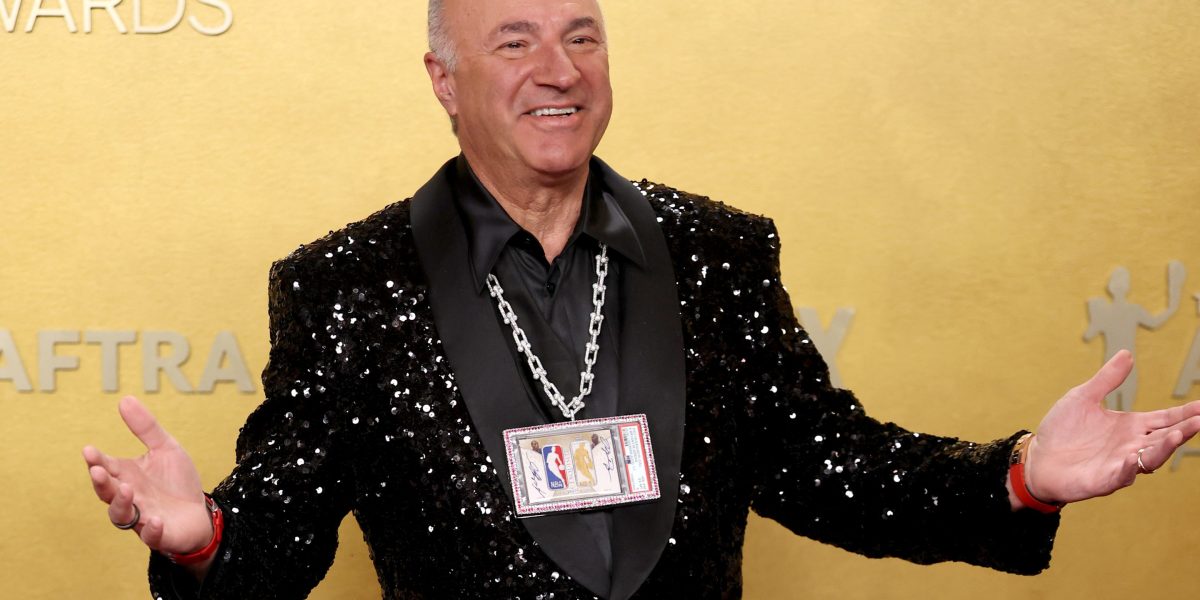
If Kevin O’Leary, 71, had to do it all over again at 25, he said he’d focus on two key areas in the tech industry to make it big.
The Shark Tank star and chairman of O’Leary Ventures said in a video this week that if he were a 20-something again, he would focus on the business that is most booming right now: artificial intelligence.
“I think AI growth is going to be exponential,” he said.
But in the vast industry of AI, O’Leary said he would focus on either helping small businesses implement AI tools or developing data centers.
Rather than go straight for the corporate giants, O’Leary said he would first try to narrow his focus to helping businesses with fewer than 500 employees implement AI. These 36 million small businesses make up just under half of the U.S. GDP, according to the Small Business Administration—and while they likely want to use AI, they may not be as quick to adapt as large corporations.
This opens up an opportunity for self-starters to help businesses get better control of their data and set up systems to analyze it with AI, he said.
“There’s going to be a massive amount of people wanting to use it that don’t know how to and they’re willing to pay to solve that pain point,” O’Leary said.
He was careful to draw a distinction, though, from traditional consulting, framing the opportunity as “implementation and execution.” O’Leary, who is an Executive Fellow at Harvard for the 2025-2026 academic year, previously told Fortune he warns his MBA students against pursuing consulting, describing the career as a “slow drift into mediocrity.”
AI’s real estate
O’Leary’s second opportunity, data center development, may take more money and a little more legwork, but is just as ripe with opportunity.
“The biggest pain point in AI is data centers,” O’Leary said. “That’s real-estate development.”
There is a mismatch today when it comes to the supply and demand in AI infrastructure, he noted. Only about 5 gigawatts of data center capacity is currently under construction, while there is demand for much more.
“The demand is insatiable,” he said.
O’Leary, for his part, has leveraged his own real estate experience into a data center development venture. He has already backed the development of a giant $70 billion data center industrial park capable of delivering 7.5 gigawatts of computing power in Alberta, Canada, though the project has faced scrutiny over its delayed timeline.
The data may be on O’Leary’s side when it comes to data centers. Goldman Sachs Research estimates the increasing use of AI will skyrocket data center power demand by 165% by the end of the decade.
Companies such as Amazon, Microsoft, and Google have poured billions into data centers, with no end in sight, and Lisa Shallet, chief investment officer for Morgan Stanley Wealth Management, said in a note from September hyperscalers’ capital expenditures on data centers and related items was nearing $400 billion annually.
For O’Leary, both opportunities in AI share a key similarity: While they may not be the most attractive corner of AI, both opportunities are involved with creating the foundation that the future AI economy needs to function.
While helping a small business deploy AI tools or securing land for a data center facility might not make for a thrilling Shark Tank pitch, in O’Leary’s mind, both opportunities could make some 25-year-olds very rich.