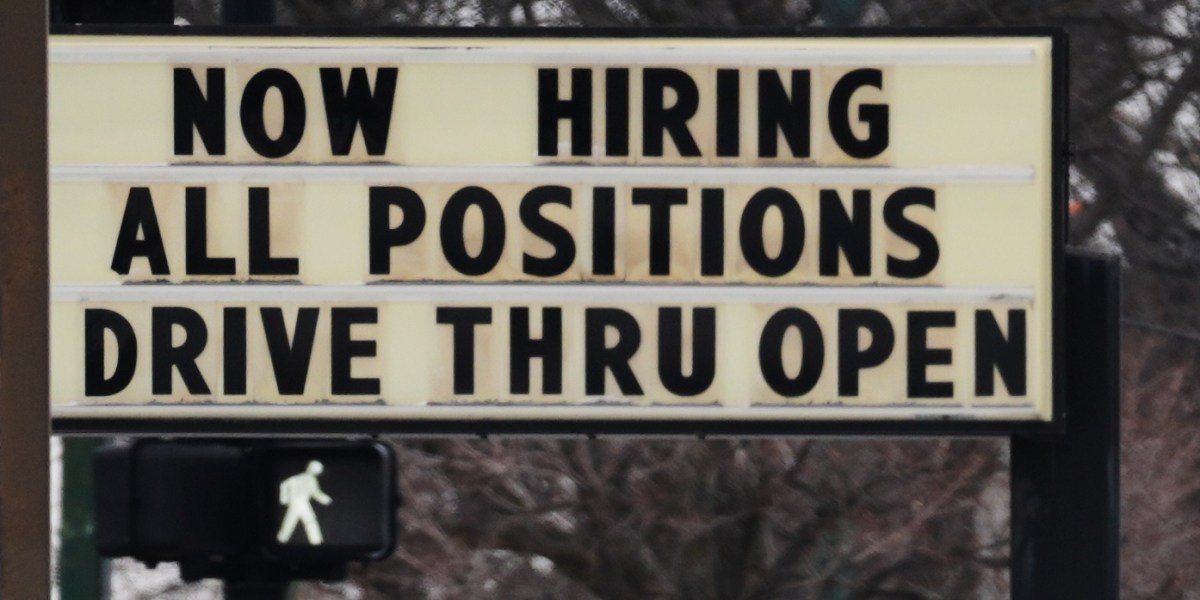




Despite a better-than-expected jobs report Wednesday, there’s a wider, inconvenient fact about life in the 21st century: labor takes home an ever smaller share of the economic pie. The pattern has been accelerating for nearly 50 years, in fact.
In the third quarter of 2025, the share of gross domestic income going to employees’ wages and benefits fell to 51.4%, down from 58% in 1980, according to U.S. Commerce Department data, as noted by The Wall Street Journal’s chief economics commentator, Greg Ip. Over the same period, corporate profits, or the leftover cash used to grow a business or pay owners, have been on the rise, reaching nearly 12% of the share of gross domestic income in the third quarter, up from 6%.
Axios ran these numbers, and calculated the decline in wages as a share of gross domestic income adding up to $12,000; as in, that’s how much less per year the average American is bringing home as a result of this dynamic. It totals some $2 trillion in annual compensation for working Americans. That would mean a nearly 20% pay boost in the annual median income.
“There’s no question that contributed to inequality and kind of the stagnation of median earnings,” Harry J. Holzer, a labor economist at Georgetown University, told Fortune.
He attributes part of this shift to the weakening of worker political power. “[It’s a] combination of automation and globalization benefiting the owners of capital more than workers and the decline in these sort of equalizing institutions like collective bargaining.”
But you don’t have to listen to Greg Ip, Axios or Fortune: the government itself is admitting that something has changed in the composition of the middle class.
A long-term pattern
A recent report released by the Congressional Budget Office reveals the extent of the growing income divide between the country’s top earners and the middle class. Between 1979 and 2022, the top 1% of households doubled their slice of the economic pie from 7% in 1979 to 14% in 2022, even after accounting for transfers and taxes. On the other hand, the share of income among the “middle three” income quintiles—households earning between $63,000 and $121,000 per year—decreased six percentage points after transfers and taxes.
If you zoom in, the disparity among the ultrawealthy paints a starker picture. While income for the highest quintile of earners, those making more than $307,000, more than doubled since 1979, the income for the top 0.01% of earners grew more than sevenfold. Sure, the country overall grew structurally wealthier, but this came with a marked increase in the wealthiest taking the lion’s share of the benefits.
The CBO report found that market income, specifically capital gains, is the main driver of the divergence. However, automation is also widening the divide. A 2022 MIT study found that automation has been the main culprit driving income inequality since 1980, with automation replacing mostly less-educated workers. Yet that study was released before the advent of AI, which is only expected to exacerbate the divide between corporate profit and labor wages and benefits.
AI development is expected to replace workers regardless of education level. Anthropic CEO Dario Amodei thinks AI could wipe out half of all entry-level white-collar jobs, and spike unemployment to up to 20% within the next five years. And college grads are entering the toughest job market in years, thanks in part to entry-level job automation.
“If we leave it to the markets, AI might really be this hugely labor-saving technology that may not be very good for workers,” Holzer said.
Last year alone, about 55,000 job cuts were tied to AI development, according to outplacement firm Challenger, Gray and Christmas. Many of those layoffs occurred in the tech industry. Microsoft slashed 9,000 jobs, citing changing strategy due to AI. And Salesforce cut 4,000 customer service jobs in an AI push.
Microsoft recently released a list of the 40 jobs most vulnerable to AI, with translators, sales reps, historians, and writers deemed some of the most affected occupations by generative AI.
To prevent a cataclysmic wave of unemployment from AI automation, Holzer suggests the government provide guardrails and incentives for tech companies to ensure AI buildout is human-first. “Government support through research grants and things like that could try to reward a more labor-augmenting or human-centered kind of AI,” Holzer said.
“I think it’s very sensible in an AI age to be thinking about how this might continue and what we might do about it. I think that’s essential.”