

Close Menu
Alpha Leaders
  • Home
  • News
  • Leadership
  • Entrepreneurs
  • Business
  • Living
  • Innovation
  • More
    • Money & Finance
    • Web Stories
    • Global
    • Press Release
What's On
Gen Z economic anxiety: ‘they get spammed and scammed, and there are tons of fake jobs out there’

Gen Z economic anxiety: ‘they get spammed and scammed, and there are tons of fake jobs out there’

4 October 2026
Warren Buffett’s first tax return showed  owed to the IRS

Warren Buffett’s first tax return showed $7 owed to the IRS

4 October 2026
Nvidia CEO Jensen Huang emerged as the biggest foil to AI doomerism’s existential risk to humanity

Nvidia CEO Jensen Huang emerged as the biggest foil to AI doomerism’s existential risk to humanity

4 October 2026
Facebook X (Twitter) Instagram
Alpha Leaders
newsletter
  • Home
  • News
  • Leadership
  • Entrepreneurs
  • Business
  • Living
  • Innovation
  • More
    • Money & Finance
    • Web Stories
    • Global
    • Press Release
Alpha Leaders
Home » The ‘Optimism Doctor’ says people can tolerate uncertainty — the AI angst is about something else
News

The ‘Optimism Doctor’ says people can tolerate uncertainty — the AI angst is about something else

Press RoomBy Press Room3 June 20264 Mins Read
Facebook Twitter Copy Link Pinterest LinkedIn Tumblr Email WhatsApp
The ‘Optimism Doctor’ says people can tolerate uncertainty — the AI angst is about something else

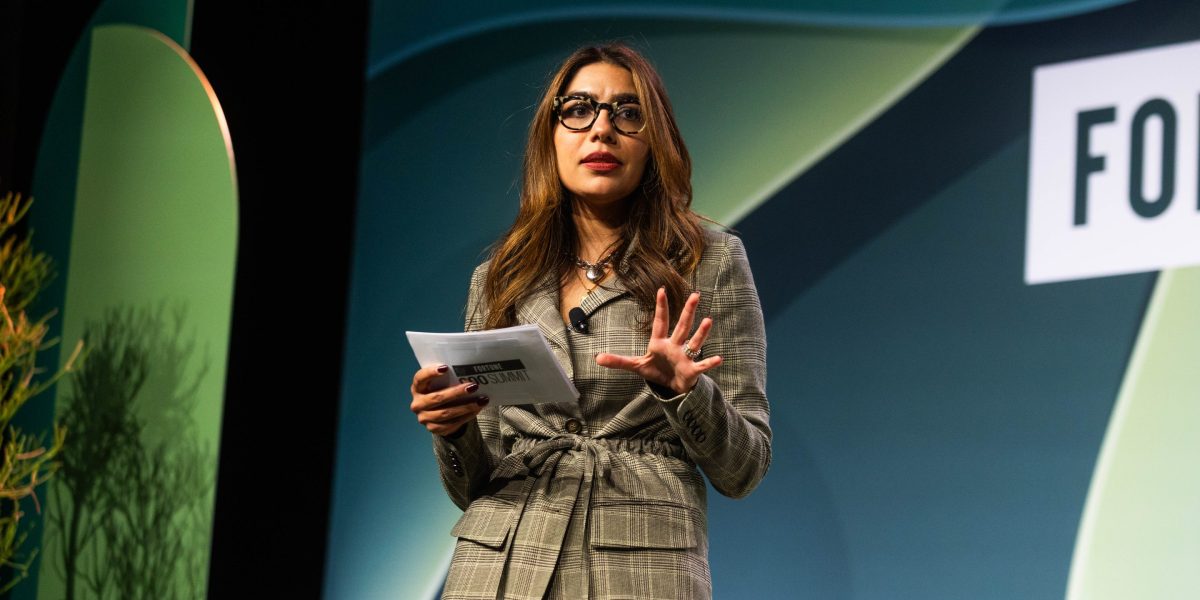
When Dr. Deepika Chopra took the stage at the Fortune COO Summit, she didn’t open with a slide deck or a framework. She asked everyone to close their eyes and breathe.

Chopra—a clinical health psychologist, behavioral scientist, and the woman who has trademarked the title “The Optimism Doctor®”—said she wanted to make a point before saying a single word about artificial intelligence: We are spending an enormous amount of time talking about the technology, and not nearly enough time talking about the humans running it.

“Every conversation about AI is ultimately a conversation about change,” she told the room. “And change is primarily not a technological experience. It’s a psychological one.”

The real resistance problem

One wonders what the COOs in the audience—many of them deep in the middle of large-scale AI adoption—made of this: a relief or a rebuke? Rolling out a major technology initiative and finding that teams resist it, misinterpret it, or quietly stall it is one of the most common frustrations in enterprise leadership right now, and a major discussion point throughout the conference. The standard response is to invest more in change management, clearer communications, better training.

Chopra’s case is that most of those responses are solving the wrong problem.

“What leaders often interpret in this moment as maybe resistance,” she said, “is something completely different sometimes. It’s a very normal human response to uncertainty. It’s not a capability problem. It’s a psychological one.”

The mechanism, she explained, is neurological. When uncertainty increases, the brain’s threat-detection system—the amygdala—activates. Thinking narrows, risk tolerance drops, creativity shrinks, and people grow more attached to familiar ways of doing things. None of that is stubbornness or sabotage, Chopra explained. It is, quite literally, the brain doing what it was designed to do: Protect the body from the unknown.

“Human beings don’t actually struggle with the hard things,” Chopra said. “We struggle with the unknown things.” What bigger unknown is there right now, after all, than AI?

It’s not about the technology

The deeper diagnosis—and the one most likely to unsettle leaders who’ve spent millions on AI change management—is that the uncertainty driving resistance isn’t primarily about job security or workflow disruption. It’s about something more fundamental.

Chopra said when she meets with clients and discusses this, “a lot of times what I’m hearing is people are asking: ‘Will I still matter? Will my contribution matter? Where do I create value?’”

She paused. “Those are not technological questions … those are deeply human ones.”

Redefining optimism

Much of Chopra’s work—including her USA Today bestselling book The Power of Real Optimism, published earlier this year—is built on dismantling the conventional understanding of what optimism actually means.

Chopra said whenever she asks a large audience what word comes to mind when they think of optimism, it’s almost always “positivity,” and she argued that’s a mistake. “I am not the most optimistic person,” she said, explaining her research shows optimism is a “psychological skill,” not a mindset. It’s something you earn, not something you wish for. The problem with positivity is that it requires a degree of certainty—a belief things will work out. And certainty, she told the room bluntly, “is a luxury that I think very few leaders have right now.”

Three things leaders can do now

Chopra left the audience with three concrete takeaways, framed not as motivational advice but as operational imperatives.

The first: Create clarity wherever you can. Not because leaders have all the answers—they don’t—but because communicating what is known, what is unknown, and what matters most right now reduces the brain’s instinct to fill the blanks with worst-case scenarios. “People can tolerate uncertainty,” she said. “What they struggle with is confusion.”

The second: Build adaptability, not certainty. Instead of trying to eliminate uncertainty—an impossible task—the better leadership question is how to help people feel capable of adjusting. Confidence, she argued, doesn’t come from guarantees. It comes from evidence of having successfully adapted before. Her practical tool here is what she calls the “three futures exercise”—asking teams facing a challenge to map out a worst-case scenario, a most-likely scenario, and a best-possible outcome, then discuss what they would do in each. The goal isn’t prediction. It’s cognitive flexibility.

The third: Don’t underestimate meaning. Purpose and contribution don’t become less important during periods of disruption. They become more important. Leaders who treat the human meaning question as secondary to the operational one are, in Chopra’s view, misreading the room.

For this story, Fortune journalists used generative AI as a research tool. An editor verified the accuracy of the information before publishing.
COO Summit Psychology
Share. Facebook Twitter Pinterest LinkedIn Tumblr Email Copy Link

Related Articles

Gen Z economic anxiety: ‘they get spammed and scammed, and there are tons of fake jobs out there’

Gen Z economic anxiety: ‘they get spammed and scammed, and there are tons of fake jobs out there’

4 October 2026
Warren Buffett’s first tax return showed  owed to the IRS

Warren Buffett’s first tax return showed $7 owed to the IRS

4 October 2026
Nvidia CEO Jensen Huang emerged as the biggest foil to AI doomerism’s existential risk to humanity

Nvidia CEO Jensen Huang emerged as the biggest foil to AI doomerism’s existential risk to humanity

4 October 2026
Gary Shapiro: why trade shows matter and how to get them right

Gary Shapiro: why trade shows matter and how to get them right

4 October 2026
‘A Republic, if you can keep it’: We served presidents from both parties and have never been so concerned about election security

‘A Republic, if you can keep it’: We served presidents from both parties and have never been so concerned about election security

4 October 2026
FDR’s lesson for AI regulation

FDR’s lesson for AI regulation

4 October 2026
Don't Miss
Trump’s Tariffs Will Make AI Data Centers More Expensive

Trump’s Tariffs Will Make AI Data Centers More Expensive

By Press Room4 April 2025

Donald Trump’s administration has gone all-in on AI: A day after his inauguration, the newly-elected…

Unwrap Christmas Sustainably: How To Handle Gifts You Don’t Want

Unwrap Christmas Sustainably: How To Handle Gifts You Don’t Want

27 December 2024
Sam Altman’s World Wants To Scan Your Eyes To Prove You’re Human

Sam Altman’s World Wants To Scan Your Eyes To Prove You’re Human

22 October 2024
Stay In Touch
  • Facebook
  • Twitter
  • Pinterest
  • Instagram
  • YouTube
  • Vimeo
Latest Articles
‘A Republic, if you can keep it’: We served presidents from both parties and have never been so concerned about election security

‘A Republic, if you can keep it’: We served presidents from both parties and have never been so concerned about election security

4 October 20260 Views
FDR’s lesson for AI regulation

FDR’s lesson for AI regulation

4 October 20260 Views
Why Gen Z is paying witches and tarot readers for guidance

Why Gen Z is paying witches and tarot readers for guidance

4 October 20260 Views
I place the world’s top software engineers and interviewed over 10,000 job seekers. The difference on paper and in person is wider than ever

I place the world’s top software engineers and interviewed over 10,000 job seekers. The difference on paper and in person is wider than ever

4 October 20261 Views

Recent Posts

  • Gen Z economic anxiety: ‘they get spammed and scammed, and there are tons of fake jobs out there’
  • Warren Buffett’s first tax return showed $7 owed to the IRS
  • Nvidia CEO Jensen Huang emerged as the biggest foil to AI doomerism’s existential risk to humanity
  • Gary Shapiro: why trade shows matter and how to get them right
  • ‘A Republic, if you can keep it’: We served presidents from both parties and have never been so concerned about election security

Recent Comments

No comments to show.
About Us
About Us

Alpha Leaders is your one-stop website for the latest Entrepreneurs and Leaders news and updates, follow us now to get the news that matters to you.

Facebook X (Twitter) Pinterest YouTube WhatsApp
Our Picks
Gen Z economic anxiety: ‘they get spammed and scammed, and there are tons of fake jobs out there’

Gen Z economic anxiety: ‘they get spammed and scammed, and there are tons of fake jobs out there’

4 October 2026
Warren Buffett’s first tax return showed  owed to the IRS

Warren Buffett’s first tax return showed $7 owed to the IRS

4 October 2026
Nvidia CEO Jensen Huang emerged as the biggest foil to AI doomerism’s existential risk to humanity

Nvidia CEO Jensen Huang emerged as the biggest foil to AI doomerism’s existential risk to humanity

4 October 2026
Most Popular
Gary Shapiro: why trade shows matter and how to get them right

Gary Shapiro: why trade shows matter and how to get them right

4 October 20260 Views
‘A Republic, if you can keep it’: We served presidents from both parties and have never been so concerned about election security

‘A Republic, if you can keep it’: We served presidents from both parties and have never been so concerned about election security

4 October 20260 Views
FDR’s lesson for AI regulation

FDR’s lesson for AI regulation

4 October 20260 Views

Archives

  • October 2026
  • September 2026
  • July 2026
  • June 2026
  • May 2026
  • April 2026
  • March 2026
  • February 2026
  • January 2026
  • December 2025
  • November 2025
  • October 2025
  • September 2025
  • August 2025
  • July 2025
  • June 2025
  • May 2025
  • April 2025
  • March 2025
  • February 2025
  • January 2025
  • December 2024
  • November 2024
  • October 2024
  • September 2024
  • August 2024
  • July 2024
  • June 2024
  • May 2024
  • April 2024
  • March 2024
  • February 2024
  • January 2024
  • December 2023
  • March 2022
  • January 2021
  • March 2020
  • January 2020

Categories

  • Blog
  • Business
  • Entrepreneurs
  • Global
  • Innovation
  • Leadership
  • Living
  • Money & Finance
  • News
  • Press Release
© 2026 Alpha Leaders. All Rights Reserved.
  • Privacy Policy
  • Terms of use
  • Advertise
  • Contact

Type above and press Enter to search. Press Esc to cancel.