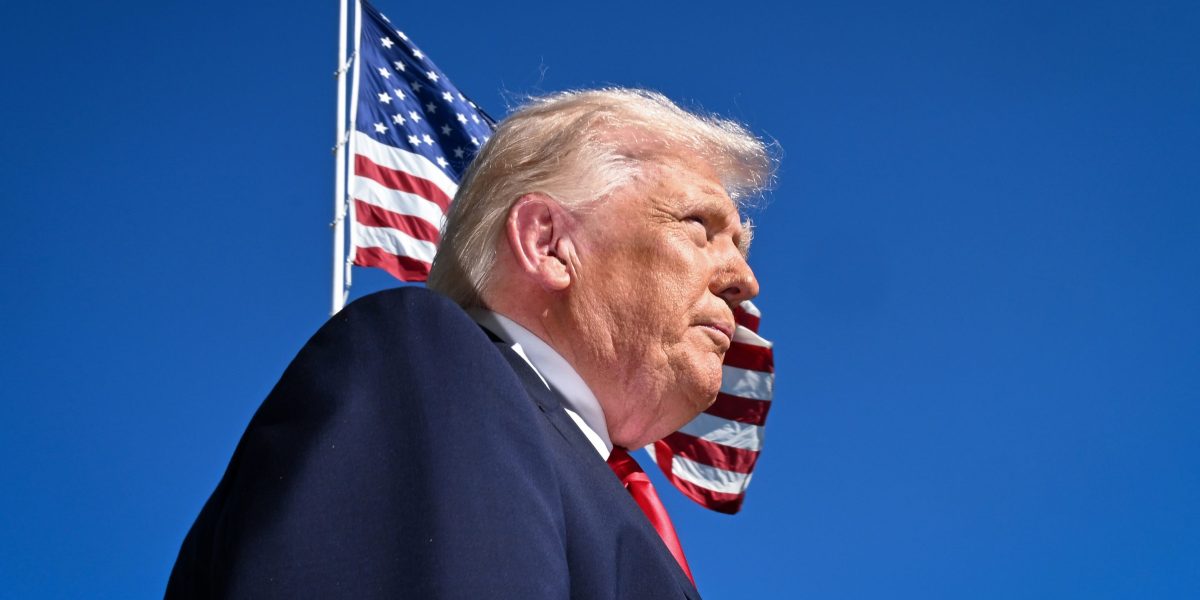


President Donald Trump posted a warning for Iran on Truth Social Monday morning, only 23 minutes after the U.S. blockade of Iran’s coastline went into effect.
“Iran’s Navy is laying at the bottom of the sea, completely obliterated—158 ships,” Trump wrote. “What we have not hit are their small number of, what they call, ‘fast attack ships,’ because we did not consider them much of a threat.”
“Warning: If any of these ships come anywhere close to our BLOCKADE, they will be immediately ELIMINATED, using the same system of kill that we use against the drug dealers on boats at Sea,” he continued.
The warning comes after 21 hours of failed negotiations with Iran in Islamabad, where officials say the sticking point was over Iranian nuclear capabilities. Once the U.S. delegation came home, Trump demanded a total blockade on Iranian ports, and a CENTCOM notice gave neutral vessels in Iranian waters until 2 p.m. UTC on Monday to leave, after which ships would be subject to “interception, diversion and capture.”
Some analysts noted Trump calculated the move to call Iran’s bluff over holding the Strait hostage; other analysts, such as Elisabeth Braw, a senior fellow at the Atlantic Council, were more skeptical, calling it a “Hail Mary” in the face of diminishing options. Two ships left the Strait Monday morning, according to Kpler data.
American crude and the national Brent crude jumped above $100 on Monday. The U.S. stock market, however, was little moved by the breakdown of the talks; the S&P was left unchanged Monday morning. An X post from a New York Post reporter citing an Iranian analyst said Iran is considering abandoning its uranium enrichment to end the war also caused a brief jump into the green Monday morning.
“Trump appears to believe a naval blockade will impose such devastating economic consequences on Iran that its leaders will have no choice but to agree to U.S. terms,” Eric Brewer, a former National Security Council official, wrote Monday morning on X. “But precisely for these reasons, we should expect Iran to try and impose its own extreme costs”—including attacks on non-Iranian-flagged ships and broader strikes on Gulf energy infrastructure. Iran, Brewer noted, has already demonstrated both the capability and the willingness.
Indeed, Iran has called the blockade “illegal” and warned that ports in Arab Gulf states are at risk if Iranian facilities come under attack. And on Monday, Parliament Speaker Mohammad Bagher Ghalibaf, who led Tehran’s delegation at the failed Islamabad talks, delivered his own warning in a register he’s grown accustomed to: one for the finance world Trump grew up in.
“Enjoy the current pump figures. With the so-called ‘blockade,’ soon you’ll be nostalgic for $4–5 gas,” Ghalibaf wrote on X, alongside the formula ΔO_BSOH > 0 ⇒ f(f(O)) > f(O).
Translated out of notation: O is the price of oil. BSOH is Blockade of the Strait of Hormuz. ΔO_BSOH > 0 means the blockade pushes prices up due to restricted supply. f(O) is that first-order effect of the blockade closing, meaning prices go up. And f(f(O)) is the second-order effect: insurers begin pulling back and shipping companies start rerouting, causing a cascade of higher prices. f(f(O)) > f(O) says the cascade is worse than the initial shock; Ghalibaf’s argument is markets have not realized the pumped price from Trump’s goading is the floor.
Oil markets seem to agree with Ghalibaf; equities traders are calling the bluff.