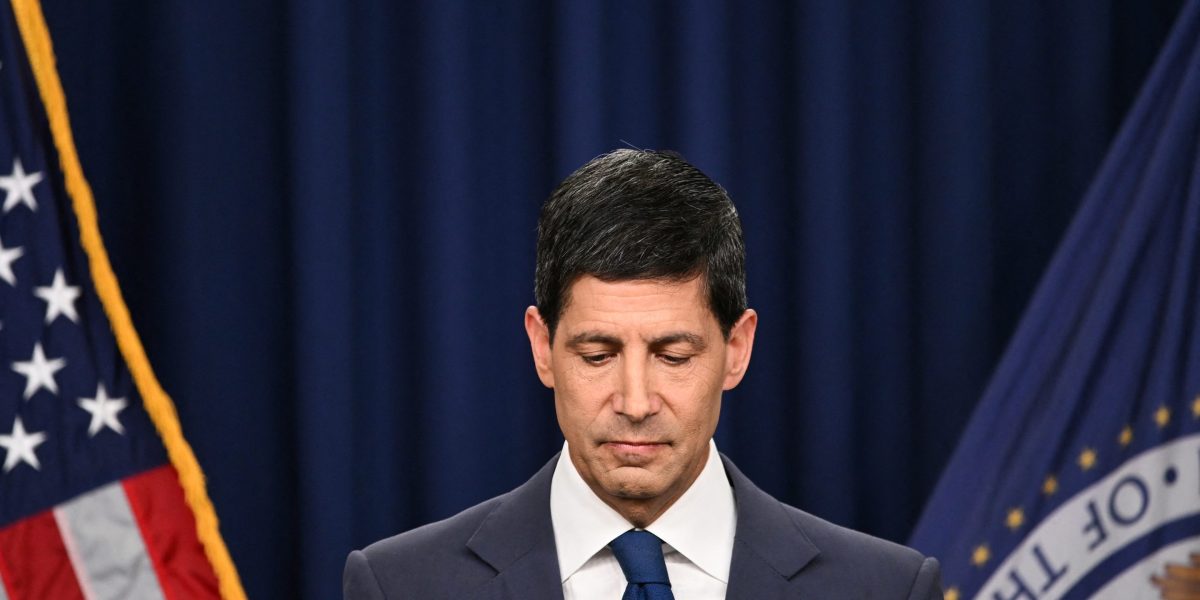




Top economic officials from the United States and China are poised to meet in Geneva on Saturday for high-stakes negotiations that could determine the fate of a global economy that has been jolted by President Trump’s trade war.
The meetings, scheduled to continue on Sunday, will be the first since Mr. Trump ratcheted up tariffs on Chinese imports to 145 percent and China retaliated with its own levies of 125 percent on U.S. goods. The tit-for-tat effectively cut off trade between the world’s largest economies while raising the possibility of a global economic downturn.
While the stakes for the meetings are high, expectations for a breakthrough that results in a meaningful reduction in tariffs are low. It has taken weeks for China and the United States to even agree to talk, and many analysts expect this weekend’s discussions to revolve around determining what each side wants and how negotiations could move forward.
Still, the fact that Beijing and Washington are finally talking has raised hopes that the tension between them could be defused and that the tariffs could ultimately be lowered. The impact of the levies is already rippling across the global economy, reorienting supply chains and causing businesses to pass additional costs onto consumers.
The negotiations will be watched closely by economists and investors, who fear that a U.S.-Chinese economic war will lead to slower growth and higher prices around the world. Businesses, particularly those that rely on Chinese imports, are also on high alert about the talks as they grapple with how to cope with the new taxes and the uncertainty about whether they will remain in place.
“Both the U.S. and China have strong economic and financial interests in de-escalating their trade hostilities, but a durable détente is hardly in the offing,” said Eswar Prasad, a former director of the International Monetary Fund’s China division.
“Nevertheless,” he added, “it represents significant progress that the two sides are at least initiating high-level negotiations, offering the hope that they will temper their rhetoric and pull back from further overt hostilities on trade and other aspects of their economic relationship.”
The Trump administration’s negotiators are being led by Treasury Secretary Scott Bessent, a former hedge fund manager who has said the current tariff levels are unsustainable. He will be joined by Jamieson Greer, the U.S. trade representative, who helped design Mr. Trump’s first-term trade agenda, which included a “Phase 1” deal with China. Mr. Trump’s hawkish trade adviser, Peter Navarro, was not scheduled to participate in the talks.
He Lifeng, China’s vice premier for economic policy, is leading the talks on behalf of Beijing. The Chinese government has not confirmed who else will be with Mr. He at the meetings or if Wang Xiaohong, China’s minister of public security, who directs its narcotics control commission, will attend. Mr. Wang’s participation would be a sign that the two sides might discuss Mr. Trump’s concerns about China’s role in helping fentanyl flow into the United States.
The trade fight has started to take a toll on the world’s largest economies. On Friday, China reported that its exports to the United States in April dropped 21 percent from a year earlier. Some of the largest U.S. companies have said they will have to raise prices to deal with the tariffs, cutting against Mr. Trump’s promise to “end” inflation.
On Friday, Mr. Trump signaled that he was prepared to begin lowering tariffs, suggesting that an 80 percent rate on Chinese imports seemed appropriate. Later in the day, referring to the China trade talks, Mr. Trump said, “We have to make a great deal for America.” He added that he would not be disappointed if a deal was not reached right away, arguing that not doing business is also a good deal for the United States.
The president also reiterated that he had suggested lowering the China tariffs to 80 percent, adding, “We’ll see how that works out.”
The Trump administration has accused China of unfairly subsidizing key sectors of its economy and flooding the world with cheap goods. The United States has also been pressuring China to take more aggressive steps to curb exports of precursors for fentanyl, a drug that has killed millions of Americans.
China has been steadfast in saying it does not intend to make trade concessions in response to Mr. Trump’s tariffs. Officials have insisted that the nation agreed to engage in talks at the request of the United States.
“This tariff war was launched by the U.S. side,” Liu Pengyu, the spokesman for the Chinese Embassy in Washington, said this week. “If the U.S. genuinely wants a negotiated solution, it should stop making threats and exerting pressure, and engage in talks with China on the basis of equality, mutual respect and mutual benefit.”
An 80 percent tariff, while a big drop from the current 145 percent, would still most likely shut off most trade between the countries.
China and the United States could take other concrete gestures to help pave the way for future negotiations, other experts said.
One option would be to scale back tariffs to about 20 percent, where they were in early April before Mr. Trump announced 34 percent levies on goods from China and mutual retaliation ensued, said Wu Xinbo, the dean of the Institute of International Studies at Fudan University in Shanghai.
“If we can scale back to that stage, then I think it will be a major progress in leading towards more constructive negotiations,” Mr. Wu said.
He said China was prepared to talk about fentanyl as a separate issue, adding that China had offered to sit down with the Trump administration in February after Mr. Trump first announced plans to impose tariffs on Chinese goods, citing the flow of illegal fentanyl into the United States.
The United States and China are meeting in proximity to the headquarters of the World Trade Organization, which has sharply criticized Mr. Trump’s tariff wars. The group has forecast that the continued division of the global economy into “rival blocs” could cut global gross domestic product by nearly 7 percent over the long run, particularly harming the world’s poorest countries. A spokesman for the W.T.O. said it welcomed the talks as a step toward de-escalation.
The alternative — a world in which the United States and China no longer engage in trade — could be economically painful and destabilizing. American consumers, who have come to rely on cheap goods from China, could soon confront thinly stocked store shelves and high prices for the products that remain.
The National Retail Federation said on Friday that import cargo traffic in the United States is expected to decline this year for the first time since 2023, when supply chain problems were persistent, and attributed the decline to Mr. Trump’s tariffs.
“We are starting to see the true impact of President Trump’s tariffs on the supply chain,” said Jonathan Gold, the retail federation’s vice president for supply chain and customs policy. “In the end, these tariffs will affect consumers in the form of higher prices and less availability on store shelves.”
The Trump administration has been racing to make trade deals with 17 other major trading partners after the president’s decision to pause the reciprocal tariffs he announced in April. On Friday, he hailed a preliminary agreement with Britain as evidence that his tariff strategy was working.
Economists have been heartened by signs that the White House appears ready to scale back tariffs.
“This rush to demonstrate progress on ‘deals’ reveals a rising desperation within the administration to roll back tariffs before they hit G.D.P. growth and inflation,” Paul Ashworth, chief North America economist for Capital Economics, wrote in a note to clients. “With the slump in incoming container ships from China raising fears of imminent shortages in the U.S., the pressure is building on the Trump administration to de-escalate that tariff buildup.”
Capital Economics estimates that if the United States lowered its tariffs on China to 54 percent, the overall effective tariff rate on imports for the United States would fall to 15 percent from 23 percent. That would put its growth and inflation forecasts back in line with its estimates from earlier this year that were based on Mr. Trump’s campaign pledges.
It remains unclear whether Mr. Trump would accept a 54 percent tariff rate.
On Friday, he suggested that he was prepared to lower tariffs to 80 percent as he gave Mr. Bessent the authority to make a deal.
“80% Tariff on China seems right! Up to Scott B.,” Mr. Trump wrote on Truth Social, his social media platform.
Later in the day, his press secretary, Karoline Leavitt, said that 80 percent figure was not an official offer and was instead “a number that the president threw out there.” She added that Mr. Trump would not lower tariffs on China unless Beijing also reduced its levies.