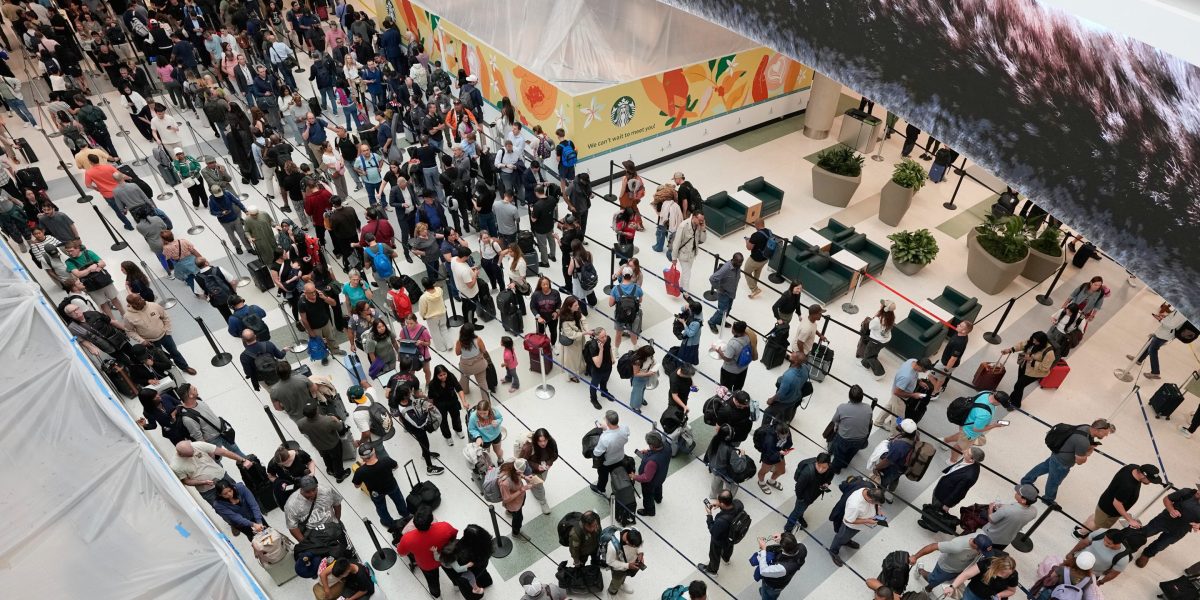





There’s good news and there’s bad news when it comes to the outlook for 2024. The good news is Wall Street seems certain there are no shocks around the corner. After the pandemic, rampant inflation, high rates, mass layoffs and upset in some of the world’s biggest companies, that’s a relief, right? Well, the bad news is that inflation, higher rates, and labor market shifts are also likely here to stay.
Welcome to 2024, the year when society’s economic headaches become standard.
Taking a look across the outlooks for next year, there’s one word that stands out from Wall Street.
“Normal” appears 23 times in Bank of America’s look at the year ahead, 11 times in UBS’s, 14 times in Goldman Sachs’s 2024 macro outlook and 11 times during its year-end roundtable.
And that steadiness isn’t just constrained to economic barometers: sectors like the labor market and the luxury goods industry are already reporting their new-found balance, though they’re not necessarily enjoying their new reality.
While some analysts on Wall Street expect certain barometers to go back to pre-pandemic levels, others are cautioning that settling of certain economic headwinds isn’t an indication of a return to 2020—it’s merely the establishment of a “new” normal.
Of course, before the outbreak of the coronavirus, the beginning of the 2020s was set to be just like any other year—and the more cautious on Wall Street are now warning peers and clients alike not to take any stability for granted.
Intervention backing off
The past few years have prompted a series of pushy interventions from governments and central banks, which have pulled every lever in their arsenal to steer global economies through uncharted waters.
This came as a special shock after a period of relatively low interest rates and inflation, which had made major sectors like the housing market comparatively accessible.
And although many on Wall Street say the Fed will take a step back to their pre-pandemic levels of intervention, they also say the uber-low rates consumers enjoyed throughout the 2010s are gone for good.
Individuals can also wave goodbye to the huge monetary and fiscal boosts they were given by governments: whether it was paying the cost of furloughing workers, tax breaks, or schemes to help consumers get back to spending.
In a roundtable with Fortune and other media outlets last month, Goldman Sachs’s chief economist, Jan Hatzius, said demand for goods had begun to outweigh demand for services.
“Some of it was driven by very, very expansionary macro policies that were then reversed in 2022, 2023, both on the fiscal and the monetary side,” he explained. “But the point is that a lot of these things have normalized, and that normalization has allowed inflation to come down without meaningful negative effects on GDP. GDP is still growing, not at a rapid pace, but at an okay pace.”
In its 2024 outlook, UBS said it expects to see inflation and rates go “back to normal,” explaining: “In our base case, we expect US and Eurozone core consumer price inflation to end 2024 in the 2–2.5% range. Key drivers include falling homeowner-related inflation, weaker consumer demand, and slower wage growth.”
The Swiss bank added it also expects to see rates cut in 2024 as the Fed disentangles itself from the innermost workings of the economy: “We believe policymakers will be sufficiently confident by midyear that inflation is falling sustainably toward target.”
Consumers go back to basics
With a return to socializing, commuting and the reopening of the leisure sector, consumers no longer have a buffer of cash they can use to splurge.
During the pandemic, the luxury sector boomed: so much so that between 2020 and 2021, LVMH boss Bernard Arnault’s fortune more than doubled from $76 billion to $186.3 billion, according to Forbes’s estimate.
“After three roaring years, and outstanding years, growth is converging toward numbers that are more in line with historical average”, LVMH’s CFO Jean-Jacques Guiony told analysts in October.
A Bank of America analyst note on the luxury sector mentions the word “normal” or “normalizing” 12 times, adding the sector’s slowdown is “driven by normalization in European and American spend, whilst Chinese demand continues to remain solid.”
Indeed, this week BofA CEO Brian Moynihan said he was watching consumers return to normal. Speaking as a hypothetical consumer, Moynihan explained: “I’m spending a little less money on goods because I bought all that stuff in the pandemic. I don’t need to buy it again. But I’m doing entertainment. I’m traveling more. And so the way consumers are spending money is leveling out.”
The leveling of consumer spending has also been offset by a return to more normal levels of saving—compounded by a normalization of government support, Hatzius highlighted.
“Excess savings were extremely important in 2022 because real disposable personal income declined sharply in 2022, partly because of the inflation surge, and partly because of the normalization of transfer payments and the reduction in COVID-related support payment,” he explained.
Hatzius added he hoped the boat will be further steadied by “very significant” rebalancing in the labour market, saying: “There’s some lag before that feeds into wage growth and price inflation.”
Indeed supply and demand factors have begun to even out in the labour sector. The latest release from the U.S. Bureau of Labour Statistics showed that the number of job openings has continued to slow (down to 8.7 million by the last day of October) while hires stayed relatively unchanged at 5.9 million.
But despite demand beginning to slip the employment rate hasn’t spiked in response, with the authority confirming both the labor force participation rate, at 62.7%, and the employment-population ratio, at 60.2%, had changed little in October compared to the month prior.
Focus on trends
Experts have also warned against drawing a straight line from pre-pandemic figures to data in 2024 and declaring normality.
Nick Bloom, an economist and professor of economics at Stanford University, pointed out the “surprising” fact that U.S. air miles are back to pre-pandemic levels of 88 billion miles a month. However, in a post on X, he continued that this figure is “12 billion miles below the pre-pandemic trend. Travel grows as people get richer and population grows, so the trend is the real benchmark.”
Examining air travel data and found something surprising. US passenger miles are back to pre-pandemic *levels* at 88bn miles a month. But they are 12bn miles below the pre-pandemic *trend*. Travel grows as people get richer and population grows, so the trend is the real benchmark pic.twitter.com/g8ZYZo0u3f
— Nick Bloom (@I_Am_NickBloom) December 3, 2023
“Business travel is not as strong [as] leisure,” Dianne Swonk, chief economist at KPMG U.S. replied, adding the trend is an “extension of hybrid and remote meetings.” She added: “Travel from [the] U.S. abroad is stronger than foreign travelers to [the] U.S.”
What could rock the boat?
And this caveat, among many others, may be why JPMorgan Chase is erring away from the “normalization” narrative and instead outlining a framework for a “new normal.”
“Our view is that the ‘new normal’ looks a lot like the ‘old normal”’ in many ways,” Jacob Manoukian, U.S. head of investment strategy at JPMorgan told Fortune. “We think that cash rates will be positive with inflation around or above 2%. What does seem like a bigger difference is the impact that government wants to have on the economy. The Inflation Reduction Act, CHIPs Act, and Bipartisan Infrastructure Bill are the largest pieces of industrial policy since the interstate highway system. The provisions are already having a meaningful impact on activity (e.g. manufacturing structures construction).”
In JPMorgan’s reality, the Fed’s 2% inflation target also represents a “floor” to the barometer as opposed to a “ceiling,” with Manoukian explaining: “We don’t think that the Fed will take their 2% inflation target literally when it comes to when to start lowering interest rates. Within portfolios, we are still focused on protecting against inflations corrosive impacts on purchasing power.”
The bank’s CEO Jamie Dimon has also been very open about the factors he fears could upend the new normal, geopolitical tensions being one of them. In September the Wall Street legend said heightened geopolitical tensions are “absolutely” the biggest threat to the global economy.
“We have dealt with inflation before, we dealt with deficits before, we have dealt with recessions before, and we haven’t really seen something like this pretty much since World War II,” he told Indian news channel CNBC TV-18.
Manoukian added the buzzphrase of 2023, AI, could also change the outlook: “We think AI is a game changer, but we are still very early in this trend, and the range of possible outcomes are wide. The internet did end up changing the world, it just took 10 to 15 years longer than most expected. The same could happen for AI.
“On the other hand, it could catalyze productivity benefits that raise potential growth and corporate profits in a way that markets have a hard time pricing in ahead of time.”