



These days Republicans and Democrats can’t seem to agree on, well, anything. But suddenly, a bi-partisan consensus is building in support of new laws that would put deficits on a sustained path to a specific goal: lowering the gulf between revenues and outlays by roughly half, to 3% of GDP. The groundswell started in earnest on January 9, when a members of the Bipartisan Fiscal Forum, a group from the House that looks for ways to address the rising fiscal challenges, introduced a resolution that would impose what I’ll call “The 3% Solution.” The proposal is more aspirational than specific: It doesn’t establish line-by-line objectives for achieving its target, for example. Still, that so many Representatives from both sides of the recognize the urgency, triggered now by a picture that deteriorating far more rapidly than almost anyone predicted just a year ago, marks an extraordinary shift in the national debate.
Even prior to the the House resolution, influential think tanks were championing the 3% target, notably the Commission for a Responsible Federal Budget. But in the past few weeks, the momentum been gaining speed. In February, hedge fund titan Ray Dalio posted on X avowing that he “loves and endorses” the idea, adding that “while the most responsible members of both parties don’t agree on much, they agree on this.” The editorial boards of the Washington Post and Bloomberg ran opinion pieces backing the goal. All the high-profile endorsements triggered a rash of stories that reprised calls from past politicians and economists for deficit caps, including Warren Buffett’s view that 3% is indeed the right number.
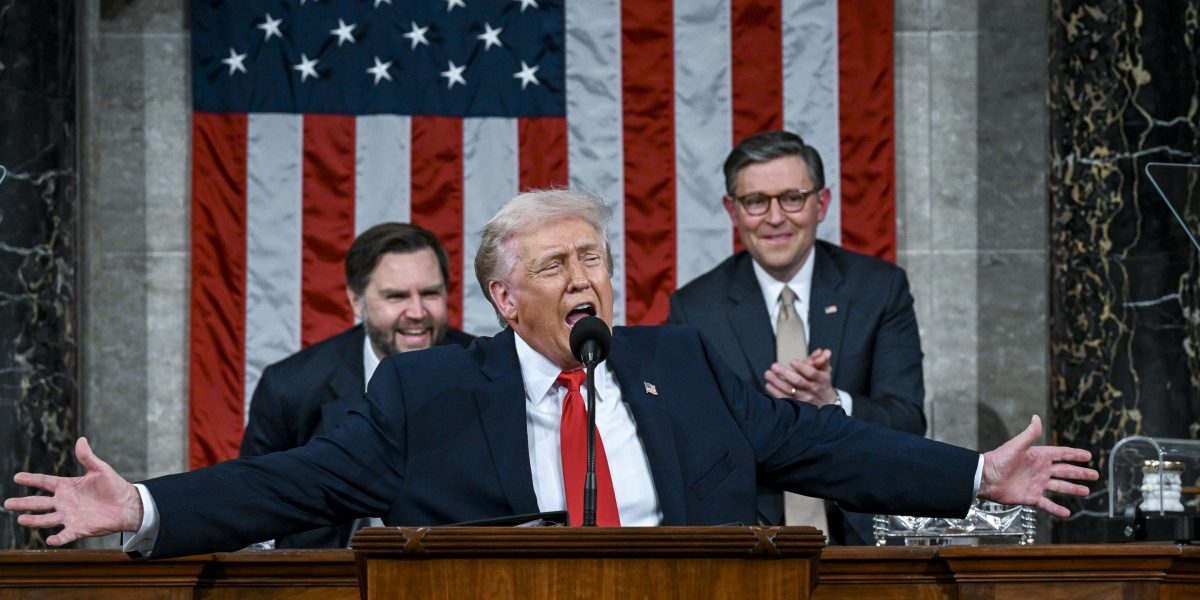
Perhaps surprisingly, another big fan is Trump’s top economic policy maker, Scott Bessent. The Treasury Secretary’s consistently argued for a “3-3-3” program what would achieve 3% growth in GDP, raise oil production by 3 million barrels a day, and push the deficit to 3% of national income, all by 2028. Of course, the Trump plan has so far sent the U.S. in the opposite direction on the budget front, and the president appears to be pretty much ignoring Bessent’s call to arms. In the State of the Union, he declared that America’s reached an economic golden age––sans addressing the challenge of achieving fiscal discipline.
Wrestling the deficit to 3% will prove a herculean task
America’s profligacy, especially since the spending blowout during and following the pandemic, have dug a hole so deep it will take a long time to climb out of, even if Congress enacted, and the president approved, a set of draconian restraints today. In FY 2026, the CBO expects the U.S. to spend $7.449 trillion and collect $5.596 trillion, meaning outlays will exceed revenues by a staggering 33%, and generate a deficit of $1.853 trillion, amounting to 5.8% of GDP. The agency by 2036 forecasts a gap that reaches 6.7% of GDP, and that estimate, according the CRFB, is probably much too low, since the CBO pencils in 0% growth in discretionary spending for the likes of defense and education. Besides, the U.S. now faces a fall in tariff revenue resulting from the Supreme Court’s ruling that most of the current border duties are illegal. The scariest feature in this scenario: Interest on the federal debt more than doubles from $1.039 trillion in ’26 to $2.144 trillion in 2036, rising at an 8% clip that makes carrying costs the fastest-growing budget item. A decade hence, interest expense would exceed Medicare outlays to rank as America’s second-largest expense after Social Security.
How tough would it be to shrink deficits by half, as so many experts want, by 2036? It would mean reducing the gap from this year’s $2.144 trillion to $1.40 trillion, or by roughly one-third. We could get there, for example, by raising a combination of income and payroll taxes by 12% over the current forecast, and also corralling entitlement spending to 12% below the number its slated to reach ten years from now. Here’s a summary of how difficult the task would be: If revenues rise on the CBO baseline that doesn’t include any new taxes, expenses would need to stay exactly where they are in 2026—in other words, go flat for 10 years and not even match the CPI—for the deficit to hit the $1.4 trillion required to notch the 3% objective.
The U.S. already has a template for a plan that could work
Remember the brief era of balanced budgets? We actually had them from 1998 to 2001. A major reason: The enactment of the Budget Enforcement Act that introduced so-called pay-as-you-go requirements, or PAYGO. The BEA stipulated that any increases in mandatory spending or tax cuts be offset by revenue-raisers or reductions in other expenditures. If not, across-the-board spending curbs would kick in on a huge swath of the entire budget, keeping a lid on deficits. Unfortunately, subsequent Congresses deployed a series of gimmicks to skirt PAYGO, including the classification of routine categories as “emergency” outlays. PAYGO rules also expired several times, and when renewed, tended to get weaker.
Still, the program provides a great template for what works. The big danger is that nothing gets done while the economy’s roaring, as it is today, and the situation becomes so unsustainable that foreigners keep dumping our debt, requiring the Treasury to pay higher and higher rates to refinance the flood of bonds coming due, a cycle that accelerates the already super-fast escalation in carrying costs. In that outcome, the U.S. might forestall a disaster by enacting an emergency national sales or value-added tax similar to those in Europe. In fact, the U.S. is the only major nation that doesn’t have a VAT or similar national levy on sales.
An unusual pair, former House speaker Paul Ryan, and liberal economist Paul Krugman, both told this writer about a decade ago that an emergency VAT was a strong possibility—Krugman argued that it was inevitable. A VAT would be bad news for America’s future. It would mean that we’ve decided to permanently make government spending a much bigger part of GDP than in the past—and pay for all of it with far higher taxes. Put simply, notaming deficits through a balance of revenue increases and lower spending, but abandoning spending discipline, the curse that afflicts Europe to this day.
President Trump should take Scott Bessent’s advice. In 1992, Ross Perot ran as a maverick presidential candidate on one major issue, the peril of huge debts, deficits and especially interest payments that were devouring the budget and leaving less and less money for the retirees, health care and defense. Perot’s insurgency helped get Bill Clinton elected over President George H.W. Bush. In the State of the Union, Trump ignored not only a crucial threat to the economy, but one that could also be a menace to his party. Trump’s speech was orchestrated to raise the Republican’s prospects in the midterms. If the deficit issue’s current momentum starts rallying voters in a big way a la 1992, Trump’s omission may prove a big mistake.