


Oil was at $97 per barrel and moving upward this morning. And as surely as night follows day, S&P 500 futures declined on that news, sinking 0.37% before the open in New York. The index was up 2.51% yesterday on the prospect of a ceasefire in the Middle East.
But as dawn broke over Asia and Europe, traders decided to lock in some of their gains from yesterday’s relief rally. The U.K.’s FTSE 100 declined 0.42% in early trading. Europe’s Stoxx 600 slipped 0.55% before lunch. Japan’s Nikkei 225 gave up 0.73%. South Korea’s KOSPI declined 1.61%.
Look on the bright side, Bespoke Investment Group told clients: “Since the lows at the end of March, the S&P has rallied 7% and is now a little more than 2% away from all-time highs.” It is also back above both its 50-day and 200-day moving averages.
“Clients sold the bounce” last week, according to Bank of America’s Jill Carey Hall. Although the S&P 500 was up 3.4% in the period, the “first up-week since the Iran conflict began, clients were net sellers of U.S. equities for the fourth week” in a row, she said in a note. They net sold $2.6 billion.
Bitcoin ticked up nearly 6% in the last five days to $71K. In case you missed it: Adam Back, responding to a New York Times investigation, denied he is Satoshi, again.
- The Fed looks hawkish. The Fed published the minutes of its last meeting and Wall Street analysts largely read them as hawkish—meaning that it’s less likely than previously thought to deliver further interest rate cuts this year. That would be negative for stock markets, where investors prefer successive rounds of cheaper money. “The ‘vast majority’ of [Federal Open Markets Committee] participants judged that upside risks to inflation and downside risks to employment are elevated, with many noting that both have intensified amid developments in the Middle East,” EY-Parthenon Chief Economist Gregory Daco said in an email. “Our baseline now incorporates just one 25 basis points rate cut in 2026, in December. It is entirely plausible that the Fed delivers no cuts this year—and that the next policy move could, in fact, be a hike.”
Oil this morning, via TradingEconomics.com:
ONE BIG THING
Warner Bros. Discovery CEO’s $887 million golden parachute
Warner Bros. Discovery CEO David Zaslav should not receive an $887 million parachute payment in Paramount Skydance’s $77.7 billion acquisition of the company, according to advisory firm ISS. Warner execs could collect a total of $1.35 billion after the deal goes through. It’s unclear if Zaslav will have a future role at the combined entity, Fortune’s Amanda Gerut explains.
IRAN CEASEFIRE
One day old and already on life support
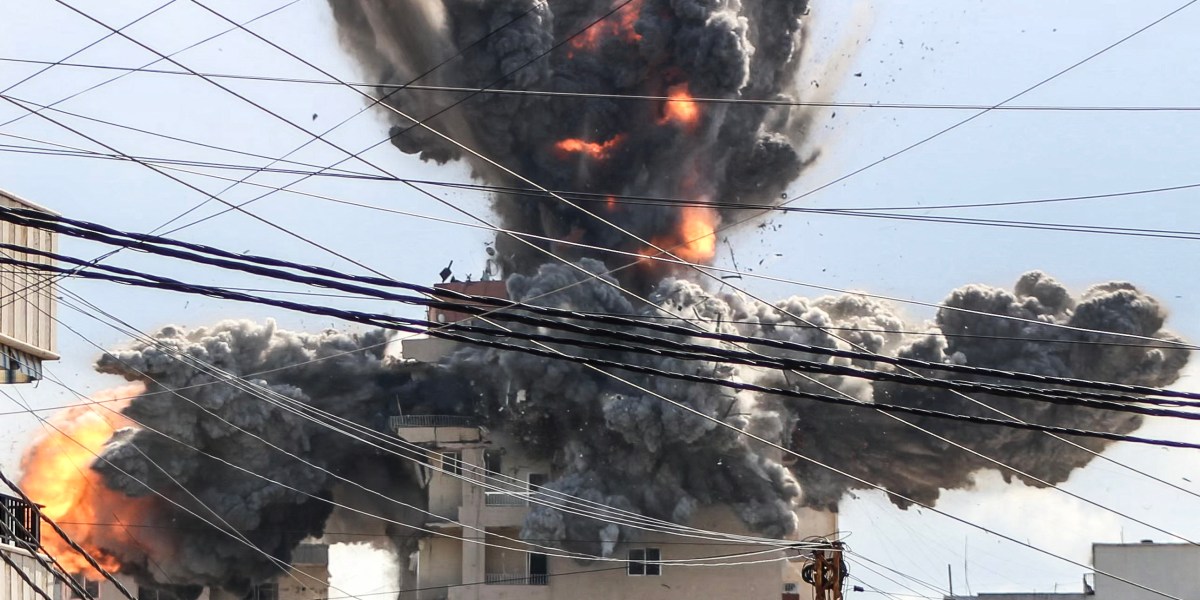
Israel struck Hezbollah positions in Lebanon yesterday. Iran accused Israel of violating the ceasefire, which is less than 24 hours old. Iran also hit positions in the UAE and Kuwait today. As Vice President JD Vance heads to the peace negotiations in Islamabad, Pakistan, Tehran threatened to withdraw from the talks unless Israel desists. Vance, in response, denied that Lebanon was covered by the ceasefire agreement.
- The Strait of Hormuz remains closed to all but a few ships granted safe passage by Tehran.
- President Trump continued to yell at everybody on social media. If Iran and the U.S. cannot come to a permanent peace, “then the ‘Shootin’ Starts,’ bigger, and better, and stronger than anyone has ever seen before,” he posted.
- Good news: There will be “NO NUCLEAR WEAPONS” used in the conflict, he said.
- He also denied the various bullet-point lists described in the media as peace proposals from both the U.S. and Iran. “There is only one group of meaningful ‘POINTS’ that are acceptable to the United States, and we will be discussing them behind closed doors.”
- He threatened tariffs on countries helping Iran, and promised Iran would be banned from further uranium enrichment.
What happens next: Iran gains more control or conflict re-escalates
The most likely scenarios moving forward involve either Iran exerting more control over global energy markets than it did before the fighting started, or the current tenuous agreement merely delays another military escalation by days or weeks, geopolitical and energy experts told Fortune’s Jordan Blum. There is a less likely “happy scenario,” where global energy trade returns to normal—but even that would take until the end of this year.
- “We think this is going to get worse before it gets better,” former White House energy adviser Bob McNally told Fortune.
The conflict will hasten a global transition toward renewables, according to Wood Mackenzie, the energy research firm. Countries that are not self-sufficient in energy—most of Asia and Europe—have realized they need to diversify quickly to not have their economies rise and fall on the whims of the White House or Tehran. The company estimates the conflict “could accelerate a structural shift in global energy systems, halving oil and gas import dependence by 2050 and reducing oil demand by 20% and gas demand by 10% relative to the base case. As countries prioritize energy security, demand is increasingly met through electrification, renewables, coal and nuclear, while reliance on globally traded fuels declines,” it said in an email.
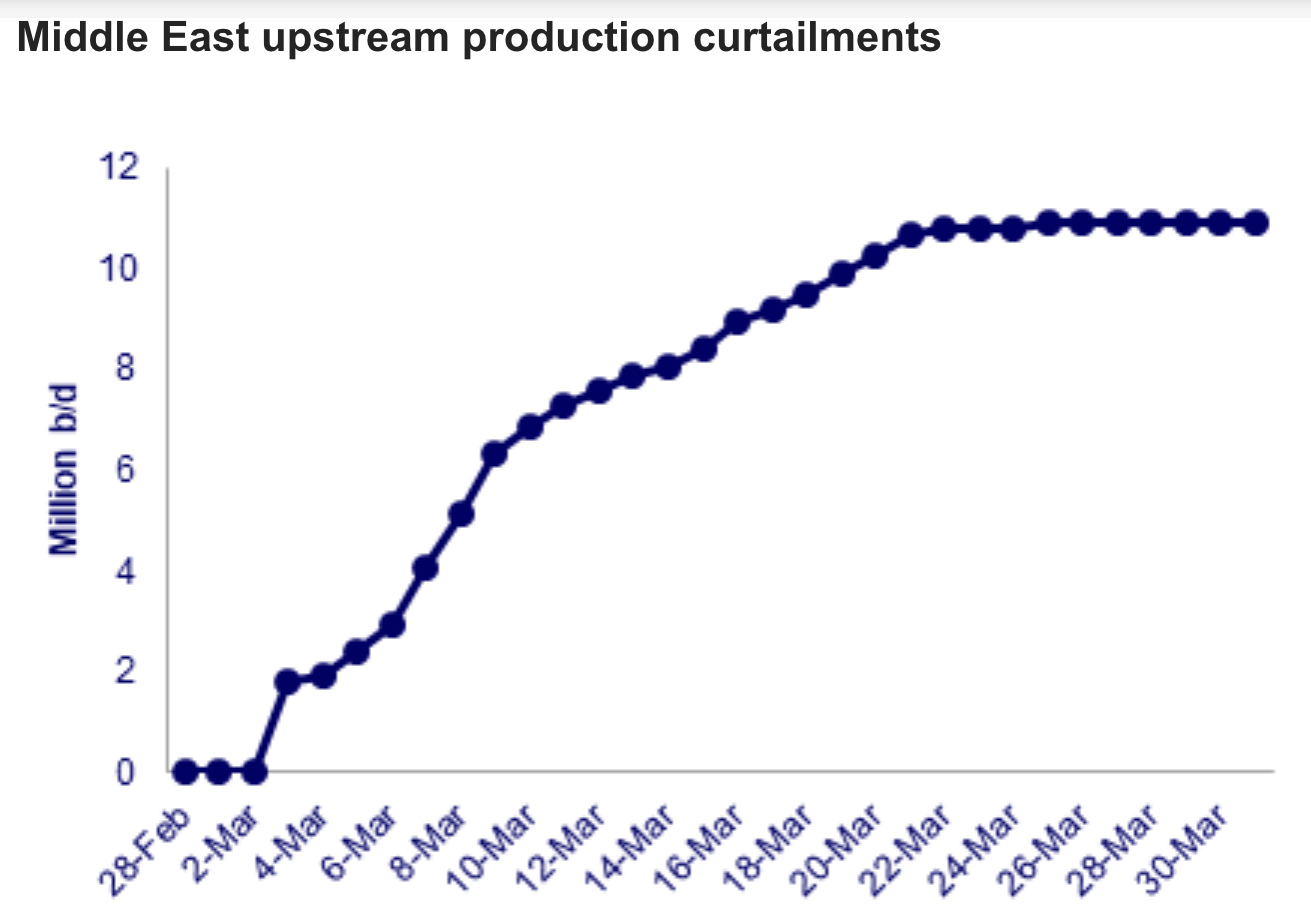
- 11 million barrels per day are currently “shut-in” (the oil industry term for offline) across the Middle East, Wood Mackenzie says:
MORE FROM FORTUNE
The New York Times says it found Satoshi Nakamoto, the inventor of Bitcoin. Not so fast – Jeff John Roberts
Why Trump’s 2027 budget could be the document that triggers a debt crisis – Shawn Tully
Meta unveils Muse Spark, its first AI model since hiring Alexandr Wang and a bellwether for CEO Mark Zuckerberg’s multibillion-dollar AI push – Jeremy Kahn
‘You can never really catch up’: The Iran war is exacerbating already high grocery bills, and it will only get worse if the war continues, experts say – Jacqueline Munis
Gen Z workers are so fearful AI will take their job they’re intentionally sabotaging their company’s AI rollout – Jake Angelo
CHART OF THE DAY
Kalshi bettors spend $3 billion a week
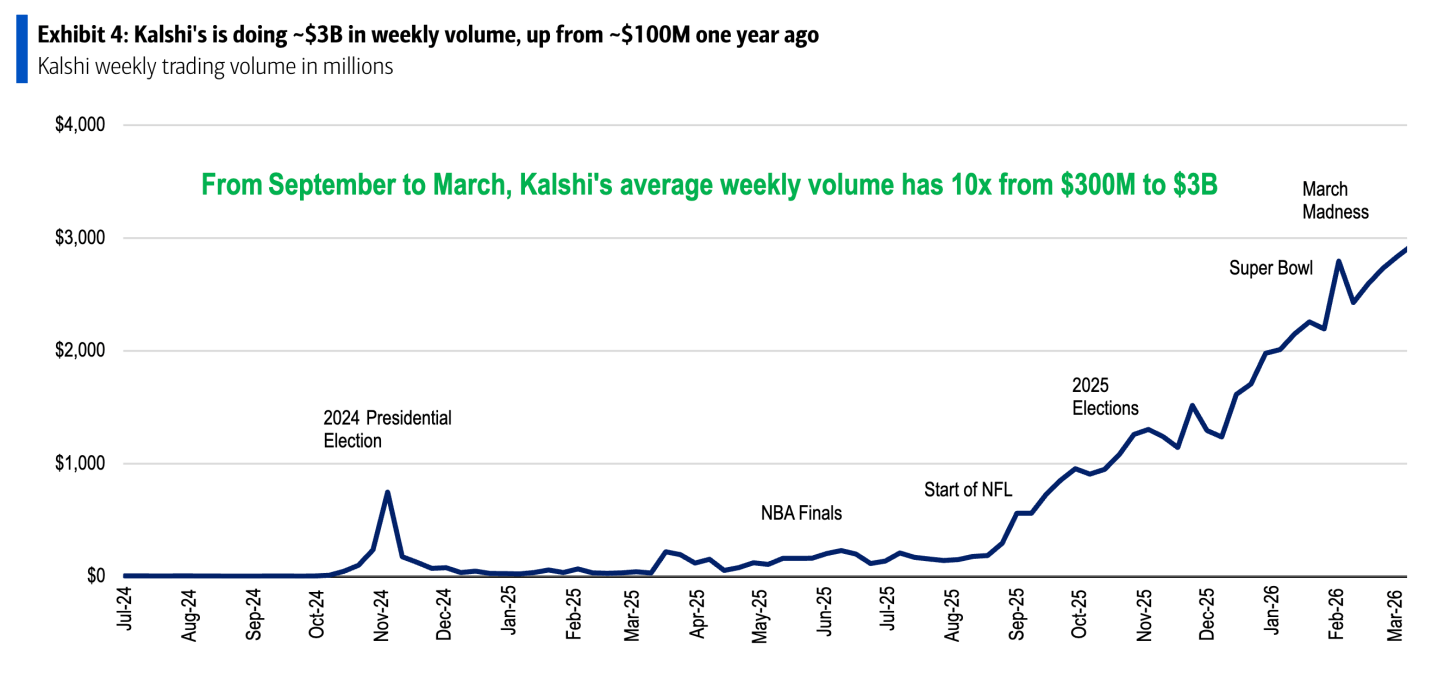
Kalshi has a 90% share of the prediction market and its trading volume has reached $3 billion per week, up from $100 million just a year ago, according to Bank of America’s Julie Hoover and Shaun C. Kelley. The company recently raised $1 billion at a $22 billion valuation.
NUMBER OF THE DAY
$1 trillion
AI, caramba: The amount that must be spent on data-center capex in order for every AI vendor’s sales expectations to be met in 2027, according to an estimate by Vivek Arya and colleagues at Bank of America. The problem, Arya argues, is that 2027 AI capex is currently only trending toward $872 billion for that year. Don’t fret, though! Arya notes that capex spending has historically been revised upward as time goes by.
THE FRONT PAGES TODAY
BDO axes 31 partner roles as AI pressure grows and profits fall – FT
Britain to call for toll-free Strait of Hormuz, says Lebanon must be part of Iran ceasefire – CNBC
Pam Bondi defies House subpoena over Epstein files – Axios
Trump Team Explores Punishment for NATO Countries That Didn’t Support Iran War – WSJ
Viktor Orban Is Fighting for His Political Life – Bloomberg
Federal Court Denies Anthropic’s Motion to Lift ‘Supply Chain Risk’ Label – NYT
ONE MORE THING
You first? On Day 1 of ceasefire, ships avoided the Strait of Hormuz
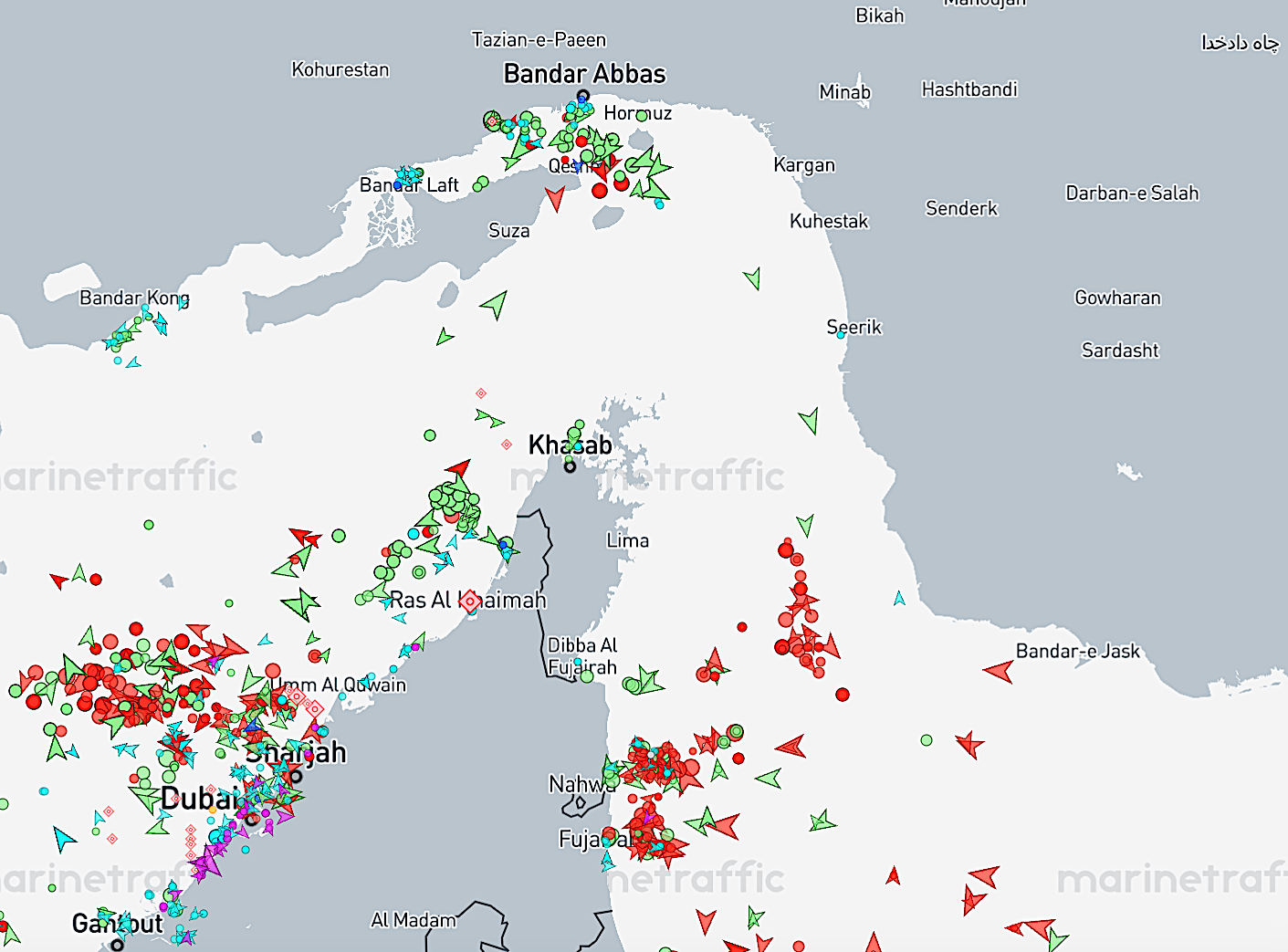
This map from MarineTraffic.com shows the narrowest pinch point in the Strait of Hormuz, with Iran to the north and Oman and the UAE to the south, on the first day of the ceasefire. Normally, about 130 ships per day happily sail through the middle of the strait. But that big gap in the middle—and the fact that many ships are hugging the northern shoreline—shows that captains were not eager to test the open-sea route without Tehran’s approval. Only seven ships have made it through the gap in the last 24 hours, according to this live tracker.