

Landing a job—especially one that is well-paid and personally fulfilling—can feel like the hardest part of building a career. But in today’s uncertain labor market, even established professionals face sudden transitions, and mid-career pivots can feel just as destabilizing as early-career ones.
Just ask Dana Perino.
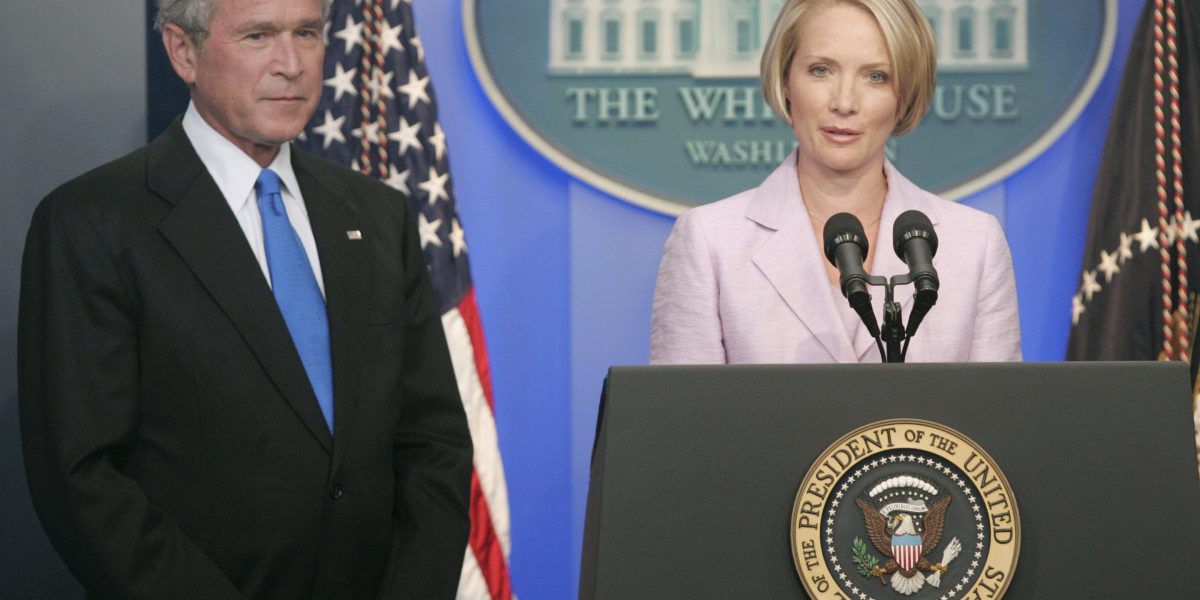
After George W. Bush’s administration ended, the former White House press secretary found herself at a crossroads. She’d spent nearly her entire career in government, so stepping outside that world wasn’t exactly a comfortable leap. She landed a public relations job—and almost immediately knew it was a mistake.
“It was pretty clear after two hours that I didn’t like it,” the now-Fox News host recently told Fortune.
Weeks in, Perino found herself back at an event with her former boss, venting about the situation. Bush responded with a question that reframed everything.
“He made me answer this question: ‘What’s the worst thing that could happen if you started your own thing and it failed? Let’s talk it through honestly,’” she recalled. “As we talked it through, it was clear I wasn’t going to become homeless and live on the street.”
By the end of the conversation, Bush delivered the takeaway: If the worst-case scenario was simply returning to another PR firm, then the risk wasn’t nearly as high as it felt.
“And he was right.”
Even with an uncertain future, Perino’s advice for Gen Z is simple: focus on what’s right in front of you
While Perino did quit and go on to start her own firm—which eventually led her to her current roles as the host of America’s Newsroom and The Five on Fox News—that kind of career uncertainty is becoming more common. Artificial intelligence is being integrated more deeply across industries, automating skills—such as coding, research, and editing—that were once the domain of specialized professionals. At the same time, companies have been quietly trimming their workforces, betting that leaner teams can drive better efficiencies.
For younger workers, the pressure is especially intense. While Gen Z is eager to enter the workforce, entry-level opportunities have tightened, and the unemployment rate for workers ages 16 to 24 reached 10.8% last year—more than twice the national average.
Perino’s takeaway is less about long-term planning and more about short-term clarity: stop trying to map out every step of your career and focus instead on the immediate opportunity in front of you—even if it isn’t perfect on paper.
That lesson, she said, showed up in her own career decisions as well. Trying to engineer a flawless long-term plan, she noted, can sometimes obscure opportunities that don’t fit neatly into it.
“Once I focused and stopped trying to do everything, all the other opportunities came at the right time,” she added.
That mindset also helped her latest project.
Perino’s first novel, Purple State, is set to hit shelves on April 21 and is centered around a young PR professional navigating her career and personal love life. The thriller draws on Perino’s years in politics and the media.
George W. Bush: ‘You ought to be open-minded as to where life takes you’
Bush has offered similar reflections on uncertainty and adaptability. During his post-presidency, he emphasized the value of flexibility over rigid life planning.
“People who plan their life when they’re 18 years old and say, ‘This is my life plan,’ would generally be surprised and maybe disappointed,” Bush said in a 2011 interview with AARP.
“I think you ought to be open-minded as to where life takes you. One of the things I learned as president is that your life is just not going to unfold the way you want it to. There will be surprises, challenges, and therefore the question is how you deal with the unexpected.”
And while Bush’s advice helped guide Perino’s brief period in her career, he’s someone who’s on both sides of the table. During his second term, he called his predecessor, former President Bill Clinton, about twice a year to talk through the challenges he was facing.
“He asked my opinion,” Clinton recalled in a video that recirculated on social media earlier this year. “Half the time he disagreed with it, but I felt good about that. I thought that was a really healthy thing.”
The 42nd president said those exchanges underscored a larger point about leadership: the value of actively seeking out perspectives that differ from your own.
“You’ve got to cultivate people who know things you don’t and have skills you don’t, and yes, that can be taught,” Clinton added.
“If nothing else, we can help people get out of their own way. Everybody’s got a story and a dream, and they can bring it to bear if we can just help people get out of their own way sometimes.”