



Child advocacy organizations Fairplay and the National Center on Sexual Exploitation (NCOSE) are filing a complaint against Roblox at the Federal Trade Commission, asking the agency to investigate the gaming giant for practices they say exploit children through manipulative monetization, addictive design features and chat systems that have enabled predators to reach minors.
The Request for Investigation, shared exclusively with Fortune ahead of its public filing on Wednesday, alleges that Roblox is violating Section 5 of the FTC Act through unfair and deceptive practices. It also calls on the commission to scrutinize the platform’s compliance with the Children’s Online Privacy Protection Act, an act Fortune has covered in the past after the FTC released an updated version of it that has left social media platforms asking for more guidance. A broad coalition is backing the effort, including Jonathan Haidt’s The Anxious Generation Movement, ParentsSOS, the Consumer Federation of America, and the Electronic Privacy Information Center.
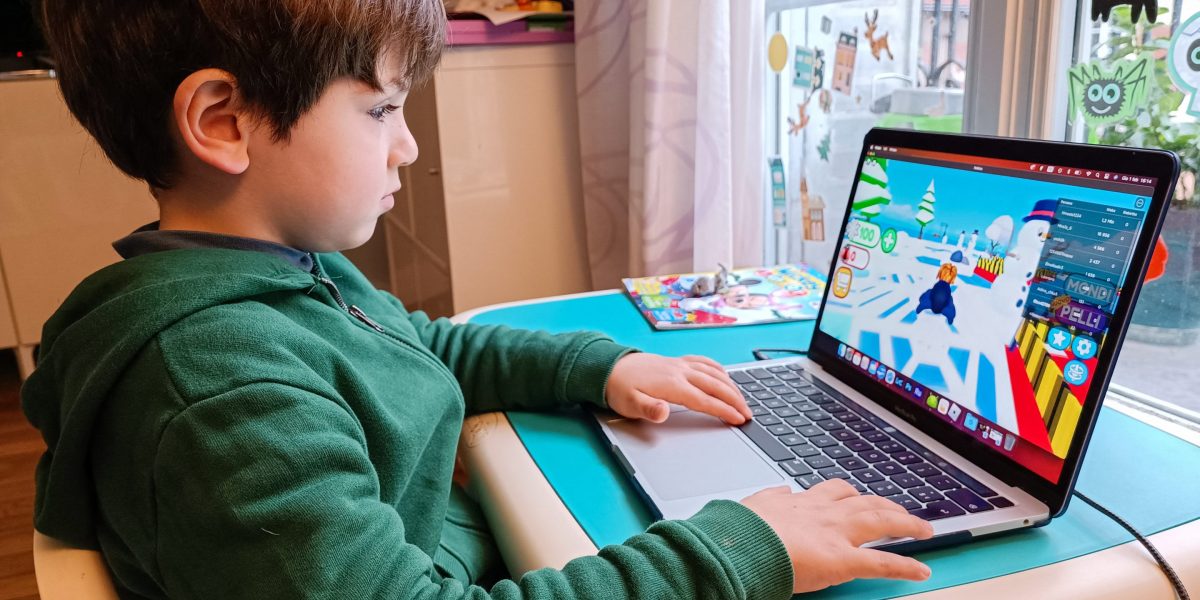
Roblox has estimated that roughly 40% of its more than 130 million daily active users are under 13 and allows children as young as 5 to create accounts. Revenue climbed to $3.6 billion in 2024, up from $2.8 billion the year before, while user engagement surged nearly 50% over three years to 73.5 billion hours. In Q1, over half of daily active users were age verified. Of those, about a third each are under 13; between 13 and 17; and over 18.
“Our platform is designed to provide a positive, healthy and enjoyable experience—we build for fun and connection, not short-term engagement,” a Roblox spokesperson told Fortune, adding that the company has safeguards and clear policies requiring fair treatment of players by game creators.
“Most games on Roblox are free to play and no-one is required to purchase Robux. In the first quarter of 2026, only 1.4% of our 132 million daily active users were payers on the platform,” the spokesperson continued. “In addition, we have clear policies prohibiting both actual and simulated gambling, and a set of rules governing how game creators can use gameplay mechanics like paid random items.”
The complaint lands amid a broader national reckoning over children’s safety online, and as age verification systems remain widely seen as easy to circumvent.
A currency system designed to obscure real costs
Roblox requires users to purchase Robux, its proprietary virtual currency, to buy in-game items. The complaint alleges the system hides real-world costs from children who lack the ability to navigate layered currency conversions. The dollar-to-Robux exchange rate fluctuates, and many experiences introduce their own secondary currencies on top of that. Roblox does not guarantee refunds or let users convert Robux back into dollars.
The filing details one parent who discovered his 10-year-old daughter had spent more than $7,000 on the platform in two months despite his attempts to impose spending caps. Another found his daughter had accumulated over $5,000 in charges without understanding she was spending real money.
The complaint catalogs design features it says are engineered to maximize time and spending on the platform, including scarcity marketing: limited-quantity virtual items that manufacture urgency despite having no production cost. The complaint also says Roblox engages in gambling-like mechanics such as loot boxes and chance-based wheels. Roblox also makes other players’ inventories visible, leveraging children’s tendency toward social comparison, the complaint read.
Chat systems that have facilitated predatory contact
The complaint claims Roblox’s chat capabilities have enabled years of predatory contact between adults and children. NCOSE researchers found in Oct. 2025 that an account registered to a five-year-old gained immediate access to dating, romance, and voice chat experiences with no verification or parental consent. Fairplay researchers using under-13 test accounts in Feb. 2026 were able to chat freely with strangers and encountered sexual references and racial slurs within minutes.
The filing documents numerous cases of children groomed, exploited, and abused by adults they met on Roblox—allegations that echo similar claims against Meta in an ongoing New Mexico case. Among the families supporting the complaint is Heather Lindquist, whose 15-year-old son Bodhi was allegedly groomed by predators on the platform. Bodhi died in December. “The parental controls on Roblox did not protect my son,” Lindquist said. “He was able to get around any protections, and his experience of grooming deeply affected his mental state.”
Roblox’s age verification system
In a statement to Fortune, Roblox pointed to recent and upcoming safety measures: age checks are now required for chat access, direct chat is off by default for users under nine, and voice chat is restricted to age-verified users 13 and older—though research suggests kids are already finding creative ways around such systems. The company said it does not encrypt chat so it can monitor for inappropriate interactions. In June, Roblox plans to launch age-based accounts that automatically match players to a curated catalog of games rated for their age group.
Fairplay Policy Counsel Haley Hinkle said, “The FTC has the authority to stop Roblox from raking in billions of dollars in profit every year at the expense of our children’s safety and healthy development.”