


It’s all-knowing, omnipresent, and somewhere between one to two billion people in the world subscribe to it.
It’s not Catholicism—it’s AI—and its usage among the world’s population is increasingly becoming a concern for some, especially as reports of how sycophantic it can be is leading to real-world harms.
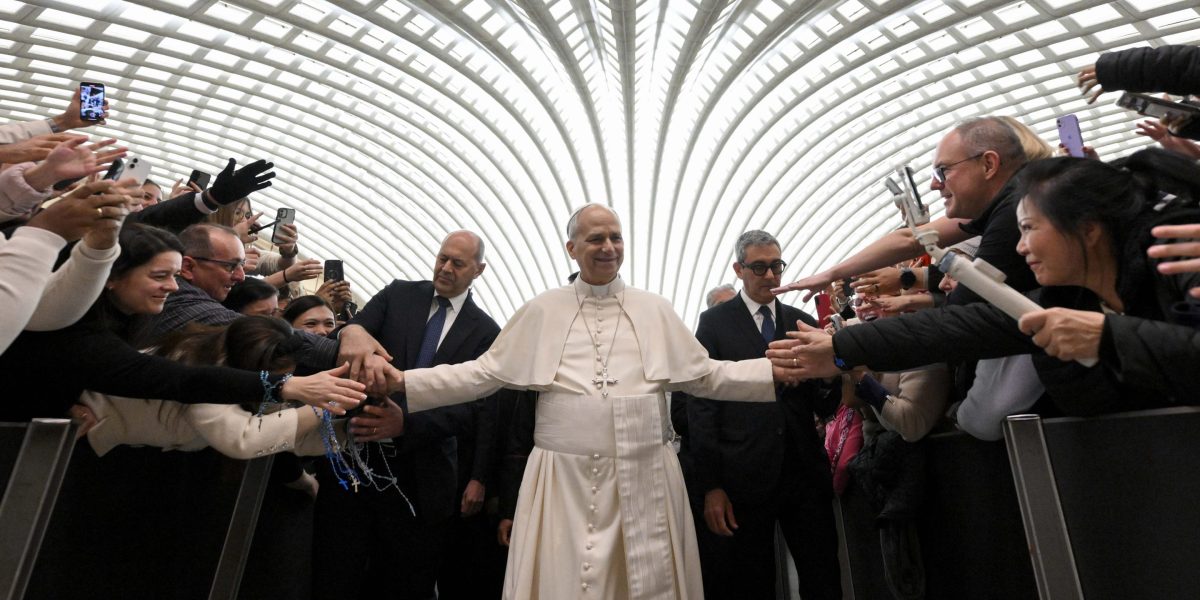
Among those concerned with its use is Pope Leo XIV, who approved the creation of a new Vatican commission on artificial intelligence on May 16. The move comes days before the pope is set to release his first papal encyclical (an official letter written by the Pope to guide bishops and practitioners on whatever subject through Catholicism) on AI usage. He’ll be joined by Christopher Olah, the Anthropic cofounder who developed Claude, on May 25.
The commission marks the first time the Catholic Church has formally coordinated its AI engagement under a single body, and arrives as governments worldwide remain divided on how, or whether, to regulate the technology.
The commission
The commission’s mandate is to facilitate the collaboration and exchange of information among Vatican bodies on AI activities and projects, including setting policies for AI use within the Holy See itself. The body draws representatives from seven Vatican institutions, including the Dicastery for the Doctrine of the Faith, the Pontifical Academy for Life, and the Pontifical Academy of Sciences.
Cardinal Michael Czerny, the prefect of the Dicastery for Promoting Integral Human Development, said the commission would help the Roman Curia “address the challenges of artificial intelligence both internally and for the whole Church, and the whole world.”
The Vatican has engaged with AI policy for over a decade: Pope Francis addressed the G7 on AI ethics in June 2024, and for years, Vatican representatives met privately with executives from Google, Microsoft, and Cisco to discuss AI ethics. But those efforts had never been formally coordinated under a single body, until now. The Vatican issued internal AI guidelines effective Jan. 1, 2025, before Leo’s election, requiring disclosure of AI-generated content, banning AI that conflicts with the Church’s mission, and establishing a five-member internal AI compliance commission.
The encyclical
The commission’s launch comes ahead of Leo’s first encyclical, which is anticipated to address AI through the lens of Catholic social teaching, covering labor rights, justice, and human dignity. The document, reportedly titled Magnifica Humanitas (“Magnificent Humanity”), will concentrate on the effects of AI on “individuals and working environments.”
Leo has drawn a deliberate parallel between the forthcoming document and Rerum Novarum, the 1891 encyclical by Pope Leo XIII (the namesake he cited when choosing his papal name) that addressed labor rights during the Industrial Revolution. Shortly after his election in May 2025, he said: “In our own day, the Church offers to everyone the treasury of her social teaching in response to another industrial revolution and to developments in the field of artificial intelligence.”
A math major turned priest
Leo XIV, born Robert Francis Prevost and the first American pope, studied mathematics before entering the priesthood. In his first address to cardinals in May 2025, he identified AI as a central challenge of his papacy and called it a threat to “human dignity, justice, and labor.”
In his first media address that same month, he acknowledged the “immense potential” of AI, but said it must be used responsibly “to ensure that it benefits everyone.” At the Second Annual Rome Conference on AI, Ethics, and Corporate Governance in June 2025, he warned AI “must never forget human dignity” and cannot interfere with proper human development, particularly for children and young people.
The pope then told teenagers that year to use AI “in such a way that if it disappeared tomorrow, you would still know how to think” and warned Gen Z against over-reliance on chatbots. Most recently, in a May 2026 address at La Sapienza University in Rome, he condemned investment in AI and high-tech weaponry as propelling the world toward a “spiral of annihilation.”
The AI commission arrives in the middle of an escalating public dispute between Leo and President Donald Trump, one that has complicated the relationship between the White House and the Vatican since the start of the U.S. war in Iran. And AI was present in this public feud as well: Trump’s account posted and then deleted an AI-generated image depicting himself in a Christ-like pose.
Unlike governments that are regulating AI through legal frameworks focused on product risk, market access, and enforcement, the Vatican is approaching the technology primarily through moral teaching centered on human dignity, labor, and the common good. The European Union comes closest with its AI Act, which bans some uses and carries fines of up to €35 million or 7% of global turnover, while the U.S. remains divided between a deregulatory federal approach and a patchwork of state measures.
In that sense, Leo’s new commission is less a regulator than an attempt to give the Church a more organized voice in a global debate it has already been shaping through repeated warnings about AI’s impact on workers, children, and human dignity.