



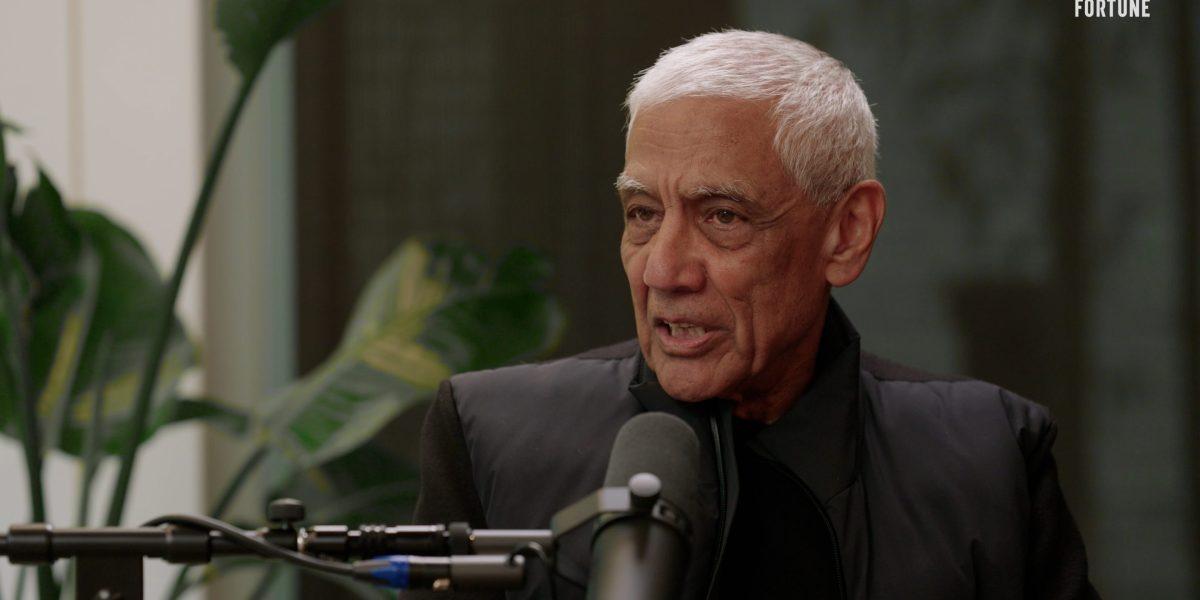
Vinod Khosla isn’t packing his bags. As a wave of Silicon Valley billionaires quietly (or even loudly) sever ties with California over a proposed wealth tax that could levy a one-time 5% charge on assets held by residents worth $1 billion or more, the legendary venture capitalist and Sun Microsystems co-founder says he’s staying put—even as he sounds the alarm about what he calls permanent damage to the state’s tax base.
“California will lose its most important taxpayers and net off much worse,” Khosla wrote on X in late December, responding to Rep. Ro Khanna’s vocal support for the measure. And in a warning that goes beyond the billionaire class, Khosla added that “even people who don’t expect this initiative to pass are still planning to leave because there will be another one.”
It’s a striking posture for one of the Valley’s most prominent voices: a man willing to criticize the policy loudly while refusing to flee it. As he told Fortune Editor-in-Chief Alyson Shontell in a recent interview on the Fortune 500 Titans and Disruptors of Industry podcast, he has “no plans to leave California.”
He argued that the state is playing a dangerous game. “You’re permanently reducing the tax base on an ongoing basis to get a one shot,” he said. “That’s what a junkie does, a one-time shot. I don’t care about the next 20 years of capital that will be taxes.”
Khosla said one estimate he saw stated a lot of the state’s wealthiest residents have already left. “Annual income from California, from that trillion that is left, is gone if this tax passes.” He did offer a suggestion of something that would tackle the state’s issues better.
A tax that’s rattling California’s billionaires class
For Khosla, a billionaire and co-founder of Sun Microsystems who made his fortune in Silicon Valley, the question isn’t just theoretical. At 71, he remains deeply invested in California’s future—literally and figuratively.
“I can’t be fired. I’ve never worried about a career. I don’t need more money,” he said. “I sort of have this freedom to do what I want.” And, as a proud Californian and American, he added that he thinks it’s important for people to speak up. “I have the luxury, so I definitely owe it to a country that’s been really good to me.”
The proposed Billionaire Tax Act—backed by the Service Employees International Union-United Healthcare Workers West and approved for signature collection by the California Secretary of State in December 2025—would require Californians worth over $1 billion to pay a one-time 5% tax on their total assets, with the option to spread payments over five years. Supporters say it could generate $100 billion to offset expected federal cuts to healthcare spending.
While the proposal is politically popular, Khosla told Shontell it “doesn’t structurally solve the problem beyond the one-time shot of income … It’s silly.” He acknowledged that the state’s social safety net, especially in health care, education, and food assistance, needs more funding, but he has been one of the loudest critics of the tax, calling Khanna’s support for it “commie” on X and accusing the congressman of acting out of personal political ambition rather than sound economic reasoning.
“So many entrepreneurs who own 20% of their company are talking about leaving now in case somebody takes another shot,” Khosla told Shontell, “because junkies come back and take another shot.”
Indeed, the measure has already triggered an exodus, even before a single signature has been certified for the November 2026 ballot. Google co-founders Larry Page and Sergey Brin have taken steps to sever ties with the state. Chamath Palihapitiya estimated that more than $1 trillion in billionaire wealth has already left California amid the fight. Gov. Gavin Newsom—himself a Democrat—has said the measure “makes no sense” and vowed to do “whatever it takes” to kill it.
Rather than a wealth levy, Khosla advocates for systemic federal reform that would fundamentally reshape how America taxes the rich—without driving them away.
“If, at the federal level, we doubled capital gains tax or made it all uniform one tax, then we will equalize and balance between economic profitability and economic growth and investment,” he explained, referring to an infamous loophole that has existed in the tax code since almost the invention of the income tax itself, in the early 20th century. His specific proposal: eliminate preferential treatment for capital gains entirely, taxing all income—whether from work or investments—at the same rate.
The twist? Use the revenue windfall to exempt most Americans from taxation altogether.
“The next presidential campaign, I hope, gets behind nobody pays income tax below $100,000 a year starting 2030,” Khosla said. “That shortfall is made up by increase in the capital gains tax to be the same as ordinary income… It makes it tax neutral, no more taxes, but much fairer distribution of income.”
This math would work in favor of working Americans, Khosla argued: “Forty percent of all capital gains is paid by people making more than $10 million a year,” he noted. “There’s 123 million people, roughly, that make less than $100,000 a year, and you make all taxes go away for them.”
His message to voters: “They will vote for a candidate who says no taxes if you make less than $100,000.” He admitted it was “just one idea” but it would at least be a structural change that would make sense. He added that he’d be surprised if some kind of structural change doesn’t happen before 2040.
Going after ‘buy, borrow, die’
Khosla’s proposal directly targets the “buy, borrow, die” strategy that allows ultrawealthy Americans to live off borrowed money secured by appreciating assets—never triggering income or capital gains taxes. When they die, their heirs inherit with a stepped-up cost basis, erasing decades of embedded gains.
Tech investor Dave Friedberg, co-host of the All-In podcast, offered a similar diagnosis: “There’s a simple way to address it, which is to charge them a capital gains tax if they borrow against their assets that they haven’t paid capital gains tax on,” he said during a recent episode. “Very simple. That can resolve this.”
Khosla framed the issue in broader economic terms: In an AI-driven future where labor becomes increasingly automated the traditional balance between labor and capital income will tilt dramatically toward capital.
“In this traditional battle of share of income to labor versus capital, it’ll shift a lot to capital, little to labor. How do you change that?” he asked. “Why should we favor people with capital, even though it increases economic growth in a world where growth isn’t in short supply? Capitalism was about efficiency, economic efficiency, but if the need for efficiency goes away because of extreme abundance, then why focus on efficiency? Let’s focus on equity.”
But his vision for structural tax reform extends well beyond state borders. “The current MAGA notion of ‘lower the taxes’ will not work,” Khosla warned, arguing that government policy will determine whether AI-driven abundance creates a utopia or a dystopia.
“Policy, which will be driven by politics, will drive where we end up,” he said. “I think it will start in the early 2030s—this massive drive for structural change.”
The irony remains sharp: California’s wealth tax may raise money once, but as long as billionaires can borrow against assets tax-free, the underlying architecture of wealth preservation remains intact. Khosla’s staying put—and betting the real battle will be fought in Washington, not Sacramento.