Synchrony is the country’s largest provider of store credit cards, and a stalwart member of Fortune’s Best Companies to Work For list. The company just claimed the No. 1 spot, rising from No. 37 just five years ago, and marking its ninth consecutive year on the list. It is the first financial services firm to top the list in 23 years.
DJ Casto, Synchrony’s chief human resources officer, has a pointed message for CEOs mandating five days back in the office: you’ve learned nothing.
“I’ve just been disappointed in how it pivoted,” he told Fortune at the Great Place to Work For All Summit in Las Vegas. He summed up the attitude as “Five days in the office, and then I’m going to check the hours and what you’re working on. But you want people motivated and engaged?”
Synchrony doesn’t check the hours. The company, which employs roughly 20,000 people across hubs in Stamford, Conn., New York City, Chicago, Orlando and Costa Mesa, Calif., operates what Casto and CEO Brian Doubles call a “flex model” — no mandated days, no tracking of badge swipes, no surveillance. And yet the company’s New York City hub at Bryant Park is so packed that employees sometimes struggle to find a seat.
“We don’t tell anybody to do it,” Casto said. “I think if you go to some of my other competitors, they’d have plenty of seats open — and they’re mandating it.”
A different kind of financial services company
To understand why Synchrony can do what JPMorgan Chase and Goldman Sachs cannot, you need to understand what Synchrony actually is.
The company issues private-label and co-branded credit cards for retail giants including Amazon, Walmart, Lowe’s, and PayPal, serving roughly 100 million customers, all digitally. Unlike traditional banks, it operates no physical branches. There is no teller window to staff, no vault to open, no walk-in customer to greet. Every customer interaction happens by phone or online, which gives Synchrony unusual latitude to extend remote flexibility to both salaried employees and hourly contact center workers alike.
That equity is more radical than it sounds. Synchrony’s contact center staff, who represent the majority of its workforce, operate under the same flex model as its senior vice presidents. Most hybrid arrangements at financial services peers apply only to white-collar, salaried staff. Synchrony’s extends to everyone.
Casto pushed back on the notion that flexibility is a white-collar perk, saying it applies from the most junior frontline associate all the way up. And critically, the flex model was not handed down from the executive suite: when Synchrony surveyed its workforce, 85% of employees said they wanted some form of remote-work option. The policy was built in response. Synchrony isn’t asking employees to trust a mandate. It’s honoring one.
The backdrop against which Synchrony is making this claim has been a sweeping, yearslong return-to-office wave across corporate America, leaving hybrid-friendly companies like Synchrony as the exception. JPMorgan Chase and Goldman Sachs moved to five-day mandates in 2025. WPP’s four-day mandate prompted an employee petition with more than 18,000 signatures. A KPMG survey found 83% of CEOs expect a full return to office within three years. A Synchrony representative told Fortune that the company has seen an increase in applicants from across the financial services sector, including large banks and other consumer finance companies.
‘The ultimate test in trust‘
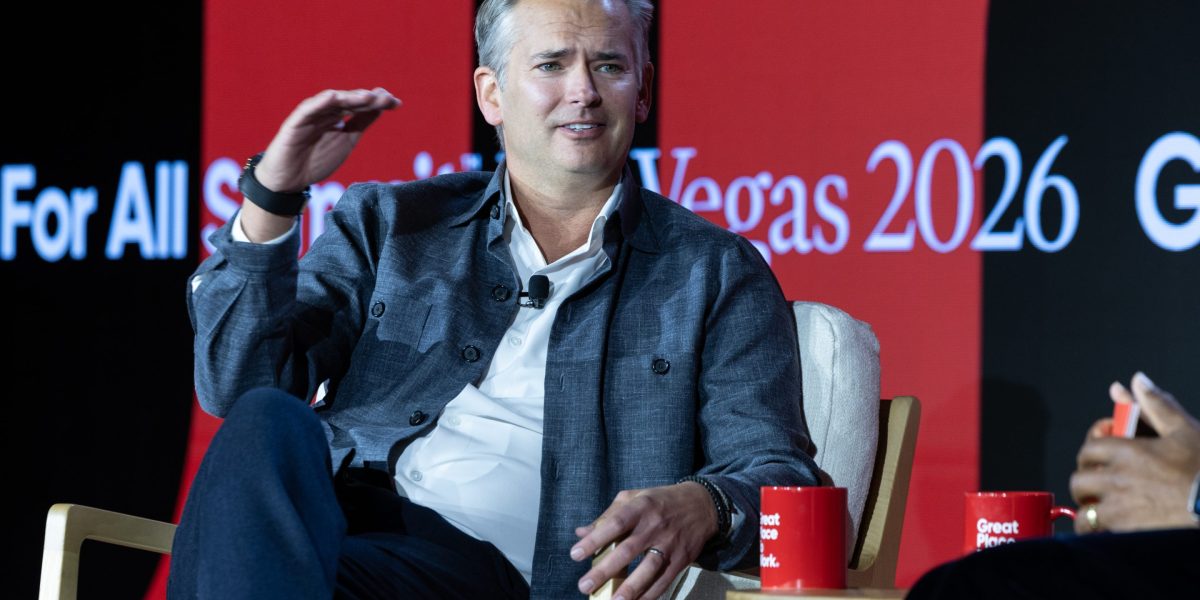
CEO Brian Doubles talked to Fortune about his own dislike of the remote environment, like when he took over the top job during the pandemic in January 2021 — when he was alone at home, on a Zoom call, with his dog sitting next to him. “You know, we had the meeting, and the board told me [I was CEO] and I was like, ‘Okay, great,’ but it was very anticlimactic.” He recalled going downstairs and celebrating with his family later that night, “but it was just not how I envisioned it.” He said it was just like the sports teams that won championships that year inside empty stadiums, celebrating in front of empty seats.
When he began thinking about how to reopen, he said he really thought about the pros and cons. “I knew that that period where we were 100% remote, it was corroding the culture a bit, right?” A culture is based on relationships and solving problems together, “and we were still doing that, but it wasn’t the same.”
At the same time, he said he appreciated that people really enjoyed being trusted to get their work done. “If you think about what is the ultimate test in trust, it really is allowing your workforce a flexible hybrid work arrangement,” Doubles said onstage in conversation with Michael C. Bush, CEO of Great Place to Work. “Our employees told us that was important to them. We listened to that when we were completely remote.”
Doubles was clear on Synchrony’s hybrid model: there are no mandates to be in the office. The company does not measure time in office. In its most recent Great Place to Work survey, 96% of Synchrony employees said they have the flexibility they need, and 93% said they feel supported to balance their work and personal lives. This is paired with a high-performance culture and close measurement of all other metrics for which employees are responsible. Both Doubles and Casto described how they’ve moved to a model of more frequent performance reviews — from annual to at least quarterly, often monthly or weekly — so employees know exactly where they stand. No matter where you’re sitting in the company, you and your manager both know how you’re performing.
“We’ve all been on teams where someone’s not delivering at the same level as others and, you know, that’s terrible for the culture. So you’ve got to nip that in the bud,” Doubles said. If you let that linger, your high performers and even middle performers are seeing that and thinking it’s unfair.
The changes have paid off financially. Since Doubles committed to permanent hybrid work in 2021, Synchrony’s earnings per share have climbed nearly fourfold, from roughly $2.27 in 2020 to $9.28 in 2025. Revenue has grown steadily.
“We measure our employees based on results and impact and outcomes,” Doubles said. “Did you deliver the project on time, on budget? Is the customer happy? But we don’t measure time in office.”
He was blunt about what the old model actually looked like. “When we were 100% in the office, were people 100% productive all the time?” Doubles recalled the days of people playing solitaire or dabbling in online shopping, not specifically referring to Synchrony’s old culture. “I just have no interest in that level of micromanagement,” he said.
The ranking itself is based on a confidential Trust Index Survey — administered directly to employees, not management — measuring credibility, fairness, respect, pride, and camaraderie. Companies must be Great Place to Work-certified before they’re eligible for the list, making it one of the harder workplace accolades to manufacture.
“That’s the cool thing about this,” Casto said. It’s not a pay-to-play arrangement, and if frontline contact center associates are much less happy your senior managers, companies won’t make the list, or take the top spot. “Flexibility shows up differently for them,” Casto said about the contact center results. “First of all, they love being able to primarily work from home. It has financially helped them a ton because, just gas. Which is big.”
What happens in case of even higher gas prices, more geopolitical strife, more economic uncertainty? “It doesn’t change my thinking at all,” Casto said. In fact, it reinforces it, “because their jobs are going to be harder. They’re going to get harder calls because there’s going to be more hardship in the ecosystem. So I need them to show up with more empathy and care.” Casto said that in the New York ecosystem, there seemed to be a vibe of “okay, pandemic’s over, back to business now.” He wondered, “Did we learn nothing?”
Despite all the hardship, Casto said the pandemic showed the world coming together with a sense of humanity and care, including in the workforce, and he wants to keep it that way, at least for Synchrony. “How do we deeply care for our people, create an ecosystem within our control to allow them to be their best both personally and professionally to drive peak performance?”
‘This isn’t an à la carte menu‘
Doubles and Casto stressed that they aren’t remote-work absolutists. Both were emphatic that in-person work matters, just not in the way most companies are enforcing it.
“There are really important things that happen in person,” Casto said. “Innovation sprints are better in person. Mentorship is better in person. Town halls are better in person.”
To Synchrony’s top 300 leaders, Doubles ssaid grooming the next generation is part of their job description, and they’re not going to do it over Microsoft Teams. He reflected on his own career. “Some of the most impactful moments were just being in a meeting I wasn’t supposed to be in … I might not have even had a speaking role, but I walked out of that with so much. It’s hard to replicate that virtually.”
The company has reduced its real estate footprint by roughly 50% while reimagining every remaining square foot around collaboration rather than individual, heads-down work. “Meeting rooms have become exponentially more important,” Casto said, adding that there’s nothing quite as frustrating as being forced into the office and then hunting around for a scarce meeting room, because the office hasn’t been configured for the videoconferencing world. This isn’t the case at Synchrony, he stressed.
Still, both leaders were wary of the entitlement — in both directions — that can creep into the flexibility conversation. “You do see entitlement build up,” Casto said. “Entitlement by the employer: ‘I’m paying you, can’t you just come in?’ And entitlement by the employee: ‘I don’t think that’s what I want to do.’ Well, this isn’t an à la carte menu. In fact … it’s work.”
Building trust before the AI wave hits
The timing of Synchrony’s cultural milestone is notable. As companies across industries brace for AI-driven workforce disruption, Doubles said the trust his company has spent five years building may be its most important asset — and that the same philosophy underpinning the flex model is now shaping how Synchrony is rolling out AI.
“We’ve just tried from the very beginning to be very transparent and open with our employees,” he told Fortune. “I think you lose credibility if you say it’s not going to impact you. It’s going to impact every single job on the planet. It just will. I truly believe that.”
Rather than softening that message, Doubles has leaned into it, while pairing the honesty with optimism. The pitch to employees isn’t that AI is coming for their jobs. It’s that it’s coming for the parts of their jobs they don’t like. “It’s going to improve the quality of their work,” he said. “It’s going to make them more efficient on the things that don’t matter as much and free up their time, their capacity — and they can redeploy that to things that are more strategic, more challenging, and that actually add more value to the company.”
Employees appear to be buying it, in part, Doubles argued, because they already trust him on everything else. In Synchrony’s most recent Great Place to Work survey, 80% of employees said they believe AI will create opportunities for them and improve their jobs. “Because they trust us generally on all aspects of the culture and the company, they believe that we’re going to leverage AI in a way that creates opportunity for the employees. And I believe we will.”
That trust, he is careful to note, is fragile. Building it, Doubles said, is slow. Losing it is not. “It takes years to earn trust, but you can lose it in seconds. And that’s what you have to watch out for.”
The flex model itself, he said, was always the biggest trust exercise of all — bigger than any benefits program or town hall or all-hands meeting. It’s paid off with a top-spot on the Best Companies list. “I never thought we’d be number one,” Doubles said, remarking at the “iconic companies” that he now keeps company with.
“Look, I think I said a couple years ago with a group of our senior leaders, I just said, ‘Wouldn’t it be cool to be a top-10 great place to work?’ That was all it was — a what if.” He paused. Doubles said he probably underestimated how much pride his employees would take in this status. “We just spent a couple of weeks, you know, multiple celebrations around the company and it’s been, it’s been pretty amazing. It’s pretty incredible to see.”