


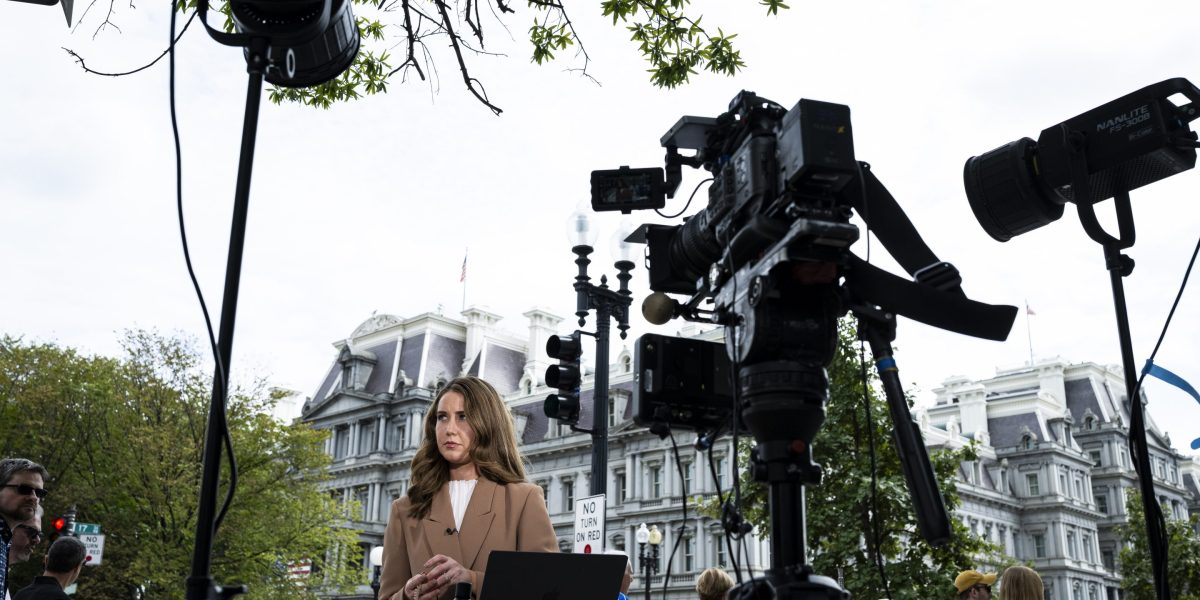
Good morning. I’ve been thinking about Steve Ballmer, Elon Musk and the prospects for American voters to get the facts they need to make informed choices in the upcoming midterm elections. In-person voting began on Friday, the same day that President Donald Trump announced that he was banning CNN, MS NOW and Politico from the White House. (Journalists from those media outlets were denied entry and had their credentials deactivated on Saturday.)
Many things will influence how Americans vote at the polls on Nov. 3, but the media and money will certainly color their perceptions.
Let’s start with the media. The quality and accuracy of information that voters receive about government leadership matters. For example, they should know that Trump has traded more stocks since returning to office than every member of Congress combined—making 28,700 trades in 17 months, or about 80 trades every market day. That analysis came from Bloomberg, not the White House. As I’ve written about previously, Trump made more money last year as president than he ever did as a CEO. And there are always scandals on both sides of the aisle. It was a Politico report on sexual assault allegations that forced Democrat Graham Platner to withdraw from the U.S. Senate race in Maine.
Trump’s ban on three outlets he doesn’t like is just the latest in a string of assaults on independent journalism and freedom of speech over the past two years. The president has filed lawsuits and claims demanding more than $70 billion since he declared his candidacy for office in November 2022. Much of that pressure has been exerted on media companies that are already suffering from the impact of AI and disinformation (some of which they have promoted, to be sure). Trump has also been sued over selling sneak peeks of his Truth Social posts for as much as $100,000 a month.
What exacerbates this information war is the ability of wealthy donors to shape the narrative by pouring billions into political advertising, thanks to the Supreme Court’s 2010 Citizens United v. FEC ruling that lifted the cap on how much corporations, unions, and individuals could spend on independent political communications. That enabled Elon Musk to donate more than $291 million to Republican candidates, political action committees, and other outside spending organizations during the 2024 election, according to OpenSecrets.
One billionaire who does not believe in channeling his wealth into influencing elections is former Microsoft CEO and Los Angeles Clippers owner Steve Ballmer, who instead has spent more than $100 million to build and fund a nonpartisan, nonprofit initiative to combat political disinformation called USAFacts. I spoke to Ballmer in August 2024, shortly after he’d launched a “Just the Facts” video series and Meta had shut down its CrowdTangle tool to track misinformation. His goal, he told me at the time, was to help journalists and “get people educated, at a minimum.”
Ballmer is now in the news for channeling his money in other ways, with the NBA suspending him for a year and severely penalizing the Clippers for circumventing its salary-cap rules. Independent journalist Pablo Torre uncovered that story and won a Pulitzer Prize for his work, reinforcing the importance of calling out corporate leaders and politicians both when they do good—and when they fall short.
Trump is not the first leader to demand deference and attack journalists as corrupt “enemies of the people” for doing their job. I’ve lived and reported in plenty of other places where accurate stories can land journalists in jail. For a media industry that’s already being battered by different forces in Washington and beyond, the 2026 midterms could prove to be a stress test of what kind of system Americans are now willing to accept.
Contact CEO Daily via Diane Brady at [email protected]
Top leadership news
From BFFs to open war
Better.com founder Vishal Garg and interim CEO Daniel Lewis, once close friends, are fighting for control of the $230 million company. Garg, ousted Aug. 3, wants five directors removed, including Lewis. ISS and Glass Lewis back the current board. The shareholder contest deadline is Oct. 20.
The new lower-income shoppers
Dollar General CEO Todd Vasos said at a Goldman Sachs conference that middle- and upper-middle-income shoppers, including some earning $100,000, now behave like lower-income consumers as inflation and $4.50-per-gallon gas squeeze budgets.
U.S. economy hits pivotal milestone
Two decades after the housing boom reshaped, then tanked, the U.S. economy, the AI boom is similarly transforming the drivers of growth. Spending on information processing equipment, which includes data centers and computer hardware, now exceeds residential investment. “We’re seeing a pivotal shift in the U.S. economy: investment is shifting away from residential investment and towards computers,” Adam Shapiro, vice president at the San Francisco Fed, said recently.
The markets
S&P 500 futures are up 0.04% this morning. The last session closed up 0.17%. The STOXX Europe 600 was up 0.67% in early trading. The U.K.’s FTSE 100 was up 0.36% in early trading. Japan’s markets are closed today. South Korea’s KOSPI was up 1.65%. China’s CSI 300 was up 0.71%. Hong Kong’s Hang Seng was up 0.92%. India’s NIFTY 50 was up 0.31%. Bitcoin is up at $81k.
Around the watercooler
The Gates Foundation is spending $400 million on AI in schools. Teachers warn it could ‘end up widening’ the divide it’s meant to close by Sydney Lake
California’s billionaire tax will ‘kickstart a movement’ that spreads to more states, the federal government and other countries, Nobel laureates say by Jason Ma
Elon Musk’s DOGE swiped $329 million in humanitarian funding from Nepal, leaving a Gen Z tech revolution to transform the budding country’s economy by Sasha Rogelberg
Hilton received 12,000 Gen Z applications for just 72 internship spots—its CHRO says AI has made the hospitality gigs more competitive by Emma Burleigh
CEO Daily is curated and edited by Joseph Abrams, Jason Ma, Claire Zillman, and Lee Clifford.