


In 2025, Americans placed roughly $166 billion in bets on sporting events. That’s more than the entire U.S. movie, music, book, and museum industries generated in revenue combined.
The North American box office totaled $8.87 billion in 2025, which is still 22% below pre-pandemic levels. Recorded music revenue hit a record $11.5 billion. Live music like concerts and festivals brought in $18.51 billion. Meanwhile, book publishers tracked by the Association of American Publishers reported $14.6 billion for the year. And the U.S. museum industry generated an estimated $16.4 billion. Add it up and the total comes to roughly $70 billion, which is less than half what Americans wagered on sports.
“It fills that void, and it will crowd out other forms of entertainment, other forms of hospitality, for sure,” said Martin “Marty” Conway, an adjunct lecturer in Georgetown University’s Sports Industry Management program. Sports gambling, in all respects, has become more ubiquitous, and as a result, is becoming more accepted as yet another form of entertainment. “They’ve taken something that was just who’s going to win, and now you’re actually able to get involved in certain other events of the game. That’s a form of engagement as opposed to what we knew previously.”
As surprising as that $166 billion figure is, the actual may be even greater, especially because several states permit betting through tribal casinos—most notably Florida, along with Washington and Wisconsin—which are not required to publicly disclose their handle. Victor Matheson, an economist at Holy Cross who studies sports gambling, said Florida alone accounts for somewhere between $5 billion and $10 billion. “The $165 or $170 billion number is low,” he told Fortune .
That figure also excludes sports wagering flowing through prediction market platforms like Kalshi and Polymarket, which have rapidly expanded into sports contracts since gaining federal regulatory clearance. Matheson estimated that activity could represent another $50 billion-$100 billion in handle. Put together, the true volume of American sports wagering in 2025—legal sportsbooks plus prediction markets plus unreported tribal handle—could approach $300 billion. In other words, the average American adult placed roughly $1,000 in legal bets on sports last year.
Handle is gross throughput, not consumer expenditure: over 90% of what is wagered gets returned to bettors in the form of winnings. That $1,000 in bets translates to roughly $100 in average losses per adult. “That overall doesn’t really seem to be a crisis,” Matheson said, but he argued the real crisis is the distribution of losses.
The best word is ‘free’
Losses are not spread evenly across the betting population. Roughly 95% of total losses are absorbed by just 5% of bettors, a small cohort of heavy users whose spending looks nothing like the casual fan putting $20 on a Sunday parlay. “That is a problem,” Matheson said.
Conway, who spent three decades as a senior executive at Major League Baseball, the Baltimore Orioles, the Texas Rangers, and AOL, said the platforms are engineered to identify and retain exactly those heavy users. “They’re able to recognize, ‘Hey, this person hasn’t really participated in two weeks. I need to spike them an offer,’” he said. “They’re very good about back-end information about when people are dropping off.”
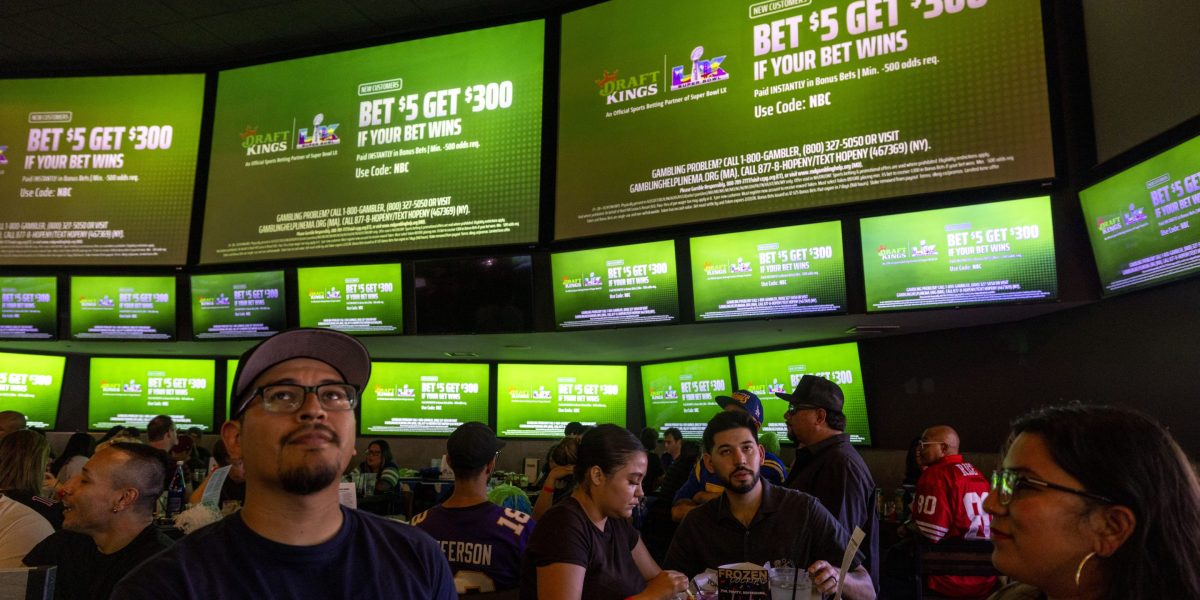
The free-bet promotions that are ubiquitous in sports advertising—which Conway said is a descendant of the old illegal bookmaking system where bettors received credit to keep wagering after a loss—are designed to pull those users back in. “The best word in marketing in the history of business has been ‘free,’” he said, “and in this case they make it appear as though it’s free, even though we know it’s really not.”
The industry barely existed in most of the country before the Supreme Court struck down the federal ban on sports betting in 2018. What followed was one of the fastest expansions of consumer activity in American history—from $6.6 billion wagered that first year to $166 billion in 2025. Matheson, who had tracked the U.K. market where sports betting has been legal for decades, said the trajectory was not entirely surprising. “The UK is betting about $1,000 per adult per year,” he said. “The states that went all in. New Jersey, New York, Massachusetts, Colorado, Arizona. They’re all at over $1,000 per person per year in handle.”
The illusion of control
What was less predictable, he said, was the demographic the legal market uncovered. Sports betting has drawn in young, college-educated men who had largely stayed out of traditional gambling. This previously untapped consumer base, Matheson said, has the illusion of control. “You say, ‘If I just knew a little bit more and studied a little bit harder, I really could make money here,’ because this isn’t craps, where the odds are what they are and I can’t throw the dice in some special way.”
That sense of a skill- or knowledge-based edge draws in people who would never buy a lottery ticket. The markets, he added, are priced specifically to neutralize whatever edge bettors think they have. “All of that knowledge is built into these bets in the first place. These lines are not being made by uneducated people.”
“It literally is just a vortex,” Conway said. “It picks up momentum, and that momentum takes it to another level.” Parlays, live in-game wagering, prop bets on individual player statistics are all engagement mechanics that sportsbooks use to turn betting into its own form of sports consumption, competing for the same hours and dollars that once went to attending games or watching them without a financial stake. “They’ve taken something that was just who’s going to win,” Conway said, “and now you’re actually able to get involved in certain other events of the game. That’s a form of engagement as opposed to what we knew previously.”
Whether that engagement is displacing spending that once went to movie tickets, bowling alleys, and concert venues remains an open empirical question. “It’s hard to believe that $100 of entertainment spending per person, because that’s what sports betting is actually costing people on average, is going to make it so that people aren’t playing video games or going to Marvel movies anymore,” Matheson said.
The clearest displacement he could point to is happening within gambling itself: lottery ticket sales at convenience stores have begun to decline in states where online sports betting has taken hold, as the more frictionless option crowds out the trip to the corner store.
A recent New York Fed study found credit card delinquencies among millennials and Gen Z have risen in states where sports betting is legal, evidence, researchers said, that some bettors are financing the habit with debt. A quarter of sports bettors now say they worry they cannot control their gambling, according to a U.S. News and World Report survey.
“With addictive products,” Matheson said, “the question is whether you kind of kill off your hosts—or whether you can string them along.”